Labels


Showing posts with label 5 Reef Animals. Show all posts

Monday, 12 January 2009

Biology: 5 Reef Animals

5. Grooved brain coral


Groved brain coral (Diploria labyrinthiformis)


The grooved brain coral is a brown or yellow hemispherical-shaped reef-building coral occurring in the Caribbean. It is most commonly found on offshore reefs at depths between 1 and 30 meters. The distinction between depth occurrences relies heavily on water quality.The grooved brain coral grows to about 2 meters in diameter. Bermudian brain corals such as D. labyrinthiformis grow upward at a rate of about 3.5 millimeters per year.

It is found in the Caribbean, the Bahamas, southern Florida, and Bermuda. D. labyrinthiformis polyps depend mostly on suspension feeding methods to obtain nourishment. By using their tentacles and extruded mesenterial filaments, the polyps prey primarily on zooplankton and bacteria.

Unfortunately, one of the least studied aspects of the degradation of the world’s coral reefs is coral disease and bleaching, and their relationship to the environment. The most recent research involving Diploria labyrinthiformis is in response to the increased occurrences of bleachng and disease. A major threat is global warming. Studies have shown that both bleaching and disease, such as black band and white plague, are associated with increased seawater temperatures.

Sources:
Marine Invertebrates of Bermuda
Wikipedia

Tuesday, 6 January 2009

Biology: 5 Reef Animals

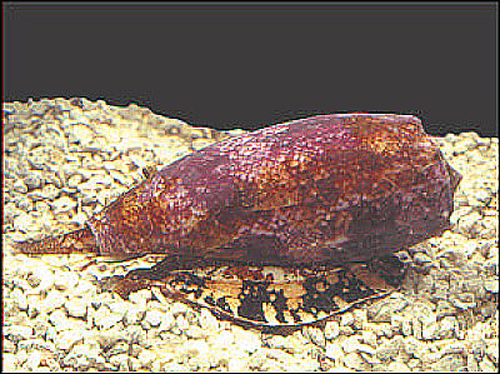
4. Geographic cone snail


Geographic cone snail

The Geographic cone snail is a gastropod of the family Conidae (cone snails 0r cone shells). These carnivorous snails are native to reefs of the Indo-Pacific. Geographic cones live in sand pockets near reef edges, under dead coral rubble or among coral reefs.

The snail is about 6 inches (15 centimeters) long. It has a lightweight and thin but not fragile shell. The background color [of the shell] is some variation of white, cream, pink or blue, heavily covered with fine brownish lines and irregular brownish blotches. They are prized by shell collectors.

The geographic cone is the most venomous of the 500 known cone snail species, and several human deaths have been attributed to them. The neurotoxins are loaded onto a barbed, harpoon like tooth made in a structure called a radula. The special tooth is used for hunting and defence.The snail shoots the harpoon still connected to the radula by a powerful muscular contraction. The venom paralyzes the prey (small fish or snails) instantly, then the snail pulls in the radula along with the harpoon and its meal.

The geographic cone is not endangered.

Intersting facts
  • The proboscis along with the harpoon can reach any part of the shell, so it must not be picked up by hand.
  • Among the compounds found in cone snail venom are proteins which, when isolated, have enormous potential as pain-killing drugs. Research shows that certain of these proteins target specific human pain receptors and can be up to 10,000 times more potent than morphine without morphine's addictive properties and other side effects.
  • The geographic cone is nicknamed the "cigarette snail," a humorous exaggeration meaning a person stung by one would have enough time to smoke a cigarette before dying.
Souces:
National Geographic
Aquarium of the Pacific: Online Learning Center
Wikipedia

Tuesday, 16 December 2008

Biology: 5 Reef Animals

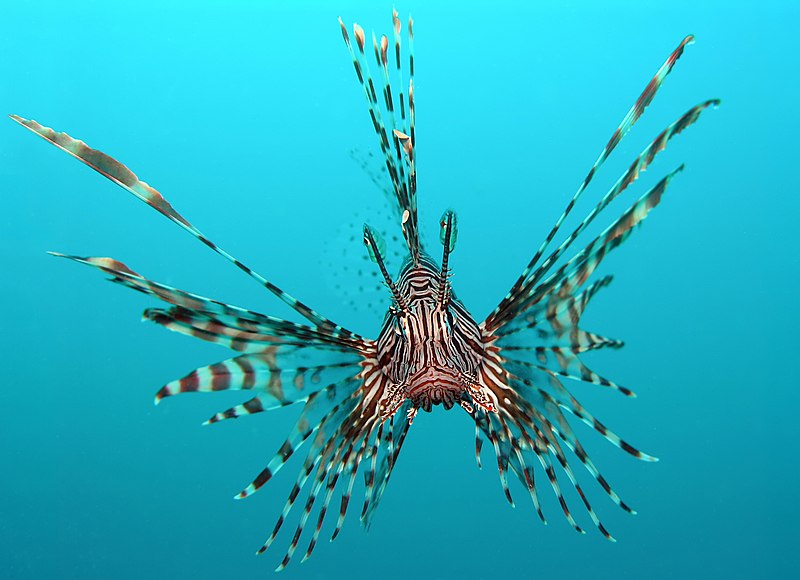
3. Lionfish


Face view


  • Family: Scorpaenidae or Scorpionfish.
  • They are also called called turkey fish, dragon fish and scorpion fish.
  • The Lionfish is any of several species of venomous marine fish in the genera Pterois, Parapterois, Brachypterois, Ebosia or Dendrochirus.
  • The lionfish is native to the tropical Indo-Pacific region of the world, but various species can be found worldwide.
  • The largest of lionfish can grow to about 15 inches (0.4 meters) in length, but the average is closer to 1 foot (0.3 meters).
  • The lionfish is one of the most venomous fish in the ocean bottom floor.
  • The venom of the lionfish, delivered via an array of up to 18 needle-like dorsal fins.
  • The spines are used only for defense, not for hunting or killing prey.
  • The venom can cause nausea and breathing problems rarely is fatal (causes death).
  • The lionfish is eaten in some countries, but is more common as an aquarium fish.
  • Their population numbers are healthy and their distribution is growing, causing some concerned in the United States, where some feel the success of this non-indigenous species presents human and environmental dangers.
Sources:
Wikipedia
National Geographic

Tuesday, 9 December 2008

Biology: 5 reef animals

2. Green Sea Turtle


Green sea turtles are a marine turtles of the sea turtle family called Cheloniidae. The green sea turtle's Latin or Scientific name is Chelonia mydas. The are cold blooded, breath oxygen and have green skin cover in scales. The are named by the color of there skin and body fat, not there shell which is normally brown or olive color.

The sea turtle's body is wonderfully adapted to life in the ocean. Their shell is lighter and more streamlined than that of land turtles. They also have flipers instead of feet to make swiming easier. When sleeping or resting, which usually occurs at night, adult sea turtles can remain underwater for more than 2 hours without breathing. This is due to the fact that turtles are capable of containing higher concentrations of carbon dioxide in their blood than most other air-breathing animals, enabling them to use their oxygen very efficiently.they also hava a salt gland behind each eye. The salt glands help sea turtles to maintain a healthy water balance by shedding large "tears" of excess salt.

Green sea turtles are one of the largest sea turtles and can weigh as much as 700 pounds (317.5 kilograms). Their proportionally small head, which is nonretractable, extends from a heart-shaped carapace that measures up to 5 feet (1.5 meters). Males are slightly larger than females and have a longer tail.

Adults eat sea grass and algea. Junvenles will aslo eat crabs, jellyfish, and sponges.

While most sea turtles warm themselves by swimming close to the surface of shallow waters, the Eastern Pacific green turtle will take to land to bask in the sun. Occasionally seen sunbathing alongside seals and albatrosses, it is one of the few marine turtles known to leave the water other than at nesting times.

Green sea turtles have long migrations to feeding and nesting areas. The life span of sea turtles in not known. Hawaiian green sea turtles seem to grow very slowly in the wild, usually taking between 10 and 50 years to reach sexual maturity - 25 years is the average. Their long period of maturation helps to explain why it takes sea turtles so many years to recover from a substantial population decline. Male and female green sea turtles look virtually alike until they mature. Then, the two sexes are easy to tell apart: the males have long, thick tails, while the females have short, stubby ones. This is an example of sexual dimorphism, or, the ability to differentiate between the sexes of a particular species on the basis of external body characteristics.

Green sea turtles nest only at night. A female crawls on land and digs a nest, lays her eggs in it and and covers them up.

Green sea turtles have been hunted for there, shells, eggs, meat, fat, and oils. Litter and other marine debris can prove deadly to sea turtles when they entangle the turtles or are mistaken for food and ingested. Sea turtle nesting beaches are lost each year to coastal development, leaving the females without a familiar place to lay their eggs. A fairly recent phenomenon recorded in Hawaii's population of green sea turtles as well as in populations off the coast of Florida is the presence of a disease called fibropapilloma.

Green turtles are listed as an endangered species, and a subpopulation in the Mediterranean is listed as critically endangered.

Sources:
hawaiimarinelife.com
www.earthtrust.org
National Geogrphic

Tuesday, 2 December 2008

Biology: 5 Reef Animals

These are some of my favorite reef animals and some facts about them.

1. Yellow tail snapper


Where found: juveniles INSHORE on grassbeds and back reefs; adults NEARSHORE or OFFSHORE over sandy areas near reefs.
Description: back and upper sides olive to bluish with yellow spots; lower sides and belly with alternating narrow, longitudinal pink and yellow stripes; prominent midlateral yellow stripe begins at mouth and runs to tail, broadening as it passes the dorsal fins; caudal fin yellow and deeply forked; no dark lateral spot.

The scientific name a of the wellowtail snapper roughly translates to "swift-swimming golden fish".

The yellowtail snapper is distributed from North Carolina to southeastern Brazil, but most abundant in the Bahamas, off south Florida and in the Caribbean.

Most females are sexually mature by age 3, when they are at least 9 inches.

The majority of animals making up the diet are found on the bottom. Most western Atlantic snappers feed predominantly on benthic fish and large invertebrates.

Sources: www.csulb.edu
www.safmc.net

Followers

About This Blog

I am a grade nine student living in Mexico. This is my home school education blog. I post the things I learned during the week on this blog. I hope you can learn things from this too.


  © Blogger template 'Photoblog II' by Ourblogtemplates.com 2008

Back to TOP