Labels


Showing posts with label Biology. Show all posts

Tuesday, 8 June 2010

Biology: Blue Desert


Whitsunday Islands.


When you see the image above, "desert" is probably the last word that comes to mind. Tropical waters are warm, clear and full of life right?

Wrong. In general tropical waters, near the equator, have less marine life than the colder temperate waters to the north and south. Here is why.

Seasons create differences in temperature throughout the year. These temperature changes cause the deep and surface water to mix. The mixing brings nutrients to the surface allowing phytoplankton to grow. This phytoplankton, being at the bottom of the food chain, feeds the rest of the food chain.With out it most marine life can't survive.

The the problem with the tropics is that with out distinguished seasons the surface water and the deep water don't mix. Without any nutrients left in the surface water, all the nutrients lie bellow 492 feet (150 m) to a depth too dark for phytoplankton to grow, leaving most of the tropical waters with less life then temperate waters.

Coastal upwellings and coral reefs act as oases in the vast blue desert. Coral reefs accumulate and recycle nutrients and in coastal upwellings deep seawater moves up to the surface.

Sources: Oceans: A Visual Guide by Stephen Hutchinson and Lawrence E. Hawkins
Photo: Wikipedia
Tuesday, 27 April 2010

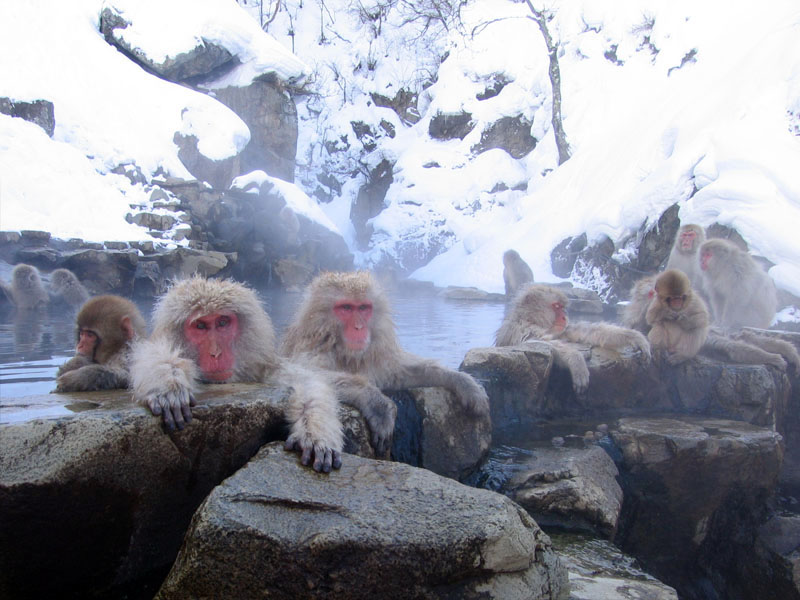
Biology: Japanese Macaque


The Japanese Macaque lives in mountainous areas of Honshū, Japan. It survives winter temperatures below -15 °C (5°F), and is perhaps most notable for the amount of time it spends in naturally heated volcanic hot springs. It has a body length ranging from 79 to 95 cm, with a tail length of approximately 10 cm.

It feeds on seeds, roots, buds, fruit, invertebrates, berries, leaves, eggs, fungi, bark, cereals and in rare cases even fish. The Japanese Macaque is a very intelligent species. It is the only animal other than humans and raccoons that is known to wash its food before eating it. The macaque has other unusual behaviors, including bathing together in hot springs and rolling snowballs for fun.

Did you know?

In recent studies it has been found that the Japanese Macaque can develop different accents, like humans.

Sources: Wikipedia

Tuesday, 13 April 2010

Biology: Fastest Animals

Fastest running animal: Cheetah.

  • Latin name: Acinonyx jubatus.
  • Speed: Between 112 and 120 km/h (70 and 75 mph). It can go from 0 to 103 km/h (64 mph) in three seconds.
  • Info: Cheetahs like to live in wide open spaces like grasslands, though they can be found in a variety of locations. The cheetah is a carnivore, eating mostly mammals under 40 kg (88 lb), including the Thomson's Gazelle, the Grant's gazelle, the springbok and the impala. The cheetah hunts by vision rather than by scent.
Sources: Wikipedia

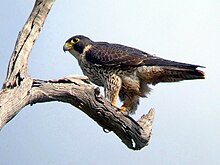
Fastest flying animal: Peregrine Falcon
  • Latin name: Falco peregrinus
  • Speed: 200 mph (320 km/h).
  • Info: The Peregrine falcon is a formidable predator. Worldwide it is estimated to prey on 1500 - 2000 bird species. Those that nest on Arctic tundra and winter in South America fly as many as 15,500 miles (25,000 kilometers) in a year.
Sources: Wikipedia, National Geographic

Fastest swimming animal: Sailfish

Latin name: Istiophorus Platypterus

Speed: 68 mph (110 km/h)

Info: The two main subspecies of sailfish, Atlantic and Indo-Pacific, range throughout the warm and temperate parts of the world’s oceans. They feed on schools of smaller fish like sardines and anchovies.

Sources: National Geographic

Tuesday, 30 March 2010

Biology: True or False?

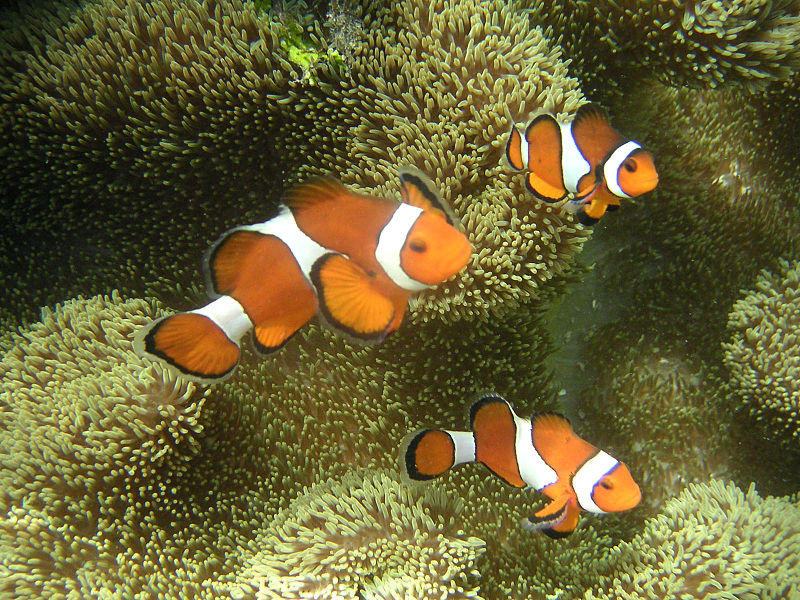
What is the difference between the True Percula Clownfish (Amphiprion percula) and the False Percula Clownfish (Amphiprion ocellaris)?

These two species are very similar but have subtle differences. The most reliable is that the True Percula Clownfish has ten spines on its first dorsal fin (the fin on top of its body closest to its head.) and the False Percula Clownfish has 11.

I believe this fits into the category of useless information. But, who knows, it may come in handy in a trivia game.


True


False


Sources: Wikipedia

Tuesday, 23 March 2010

Biology: Hippo and Tortoise

This is the story of a hippopotamus named Owen and a giant tortoise named Mzee.

Just before Christmas the unseasonably heavy rains near Malindi, Kenya washed a family of hippopotamuses down the near by Sabaki River and out to sea. The residents of the town tried in vain to urge the family back up the estuary. When a Tsunami hit Malindi the hippos disappeared and were forgotten as all efforts went to rescuing the stranded fishermen.

The next day only a stranded baby hippo could be seen.With ropes, boats, nets and cars the hippo was captured and provided a home by Lafarge Eco Systems. The hippo was named 'Owen' in honor of the volunteer who tackled him to the ground. Exhausted, confused and extremely frightened, Owen immediately ran to the safety of a giant tortoise when we released him in Haller Park.

The tortoise, named Mzee, was 130 years old. Mzee quickly came to terms with his new friend and even returned signs of affection. The unusual relationship between this baby hippo and the ancient tortoise amazed people the world over and has featured in most countries on television and in news papers.

Owen will eventually be moved to a bigger pond in Haller Park were he can socialize with other hippos.

Sources: npr.org

Tuesday, 26 January 2010

Biology: Antarctic Icefish


The Antarctic Icefish are a cold colored, cold blooded group fish from the cold waters around Antarctica. Most live at seawater temperatures between of –2°C and 4°C, but some sub-polar species inhabit waters that may be as warm as 10°C around New Zealand and South America.

But at –2°C wont water freeze? Well, freshwater would freeze, but the salt in seawater gives it a lower freezing point.

The reason icefish don`t freeze is because the blood contains a natural anti-freeze. Also, icefish only have 1% hemoglobin in their blood as opposed to the 45% in most animals. Because of this their the fish appears ghostly white. These fish are able to survive without large amounts of hemoglobin in part because of the high oxygen content of the cold waters of the Southern Ocean, and in part because oxygen is absorbed and distributed directly by the plasma. It eats small fish and krill.

Sources: Wikipedia
(Book) Ocean by The American Museum of Natural History.

Tuesday, 22 December 2009

Biology: Marine Iguana


The Marine Iguana (Amblyrhynchus cristatus) is an iguana found only on the Galápagos Islands that has the ability, unique among modern lizards, to live and forage in the sea.

Adult males are up to 1.7 m long, females 0.6 - 1 m, males weigh up to 1.5 kg.

As an cold blooded animal, the marine iguana can spend only a limited time in the cold sea, where it dives for algae. However, by swimming only in the shallow waters around the island they are able to survive single dives of up to half an hour at depths of more than 15 m. After these dives, they return to their territory to bask in the sun and warm up again. When cold, the iguana is unable to move effectively, making them vulnerable to predation, so they become highly aggressive before heating up (since they are unable to run away they try to bite attackers in this state).

Sources: Wikipedia

Friday, 18 December 2009

Biology: Wax Palm Tree


Cocora valley with wax palms.


The tallest palm in the world. The palm is native to the Andean high altitude valley of Cocora in the department of Quindío, northwest Colombia. The wax palm grows up to 50 m (rarely to 60 m) tall in good growing conditions. The trunk is cylindrical, smooth, light colored and covered with wax, When the leaves die they fall and this forms a dark ring around the trunk.

The palm faced extinction due to human action. The wax of the trunk was used to make candles, until the introduction of electricity a few decades ago.

Tuesday, 15 December 2009

Biology: Record Breaking Trees

Tallest Trees

  1. Coast Redwood (Sequoia sempervirens): 115.56 m (379.1 ft).
  2. Australian Mountain-ash (Eucalyptus regnans): 99.6 m (326.8 ft)
  3. Coast Douglas-fir (Pseudotsuga menziesii): 99.4 m (326.1 ft)
  4. Sitka Spruce (Picea sitchensis): 96.7 m (317.3 ft)
  5. Giant Sequoia (Sequoiadendron giganteum): 94.9 m (311.4 ft)
Largest Trees

  1. Giant Sequoia Sequoiadendron giganteum: 1,487 m³ (52,508 cu ft) Name: General Sherman
  2. Coast Redwood Sequoia sempervirens: 1,203 m³ (42,500 cu ft) Name: Lost Monarch
  3. Montezuma Cypress Taxodium mucronatum: 750 m³ (25,000 cu ft) Name: Árbol del Tule
  4. Western Redcedar Thuja plicata: 500 m³ (17,650 cu ft ) Name: Quinault Lake Redcedar
  5. Kauri Agathis australis: circa 400 m³ (15,000 cu ft) Name: Tane Mahuta tree (total volume, including branches, 516.7 m³/18,247 cu ft)
Oldest Trees
  1. Great Basin Bristlecone Pine (Methuselah) Pinus longaeva: 4,844 years
  2. Alerce Fitzroya cupressoides: 3,622 years
  3. Giant Sequoia Sequoiadendron giganteum: 3,266 years
  4. Sugi Cryptomeria japonica: 3,000 years
  5. Huon-pine Lagarostrobos franklinii: 2,500 years
Sources: Wikipedia

Tuesday, 8 December 2009

Biology: Red Crab Migration.


On Christmas Island in the Indian Ocean a sea of red migrates from the forested plateau to the shore and back every year. This is the annual migration of the red crab.

The red crabs go to the shore to breed and to replace water and body salts lost in the trip to the shore. The total migration, to the shore and back, takes three lunar cycles or three months starting in early November. Along the way they face with dehydration, roads and railway tracks.
Though things like road closures and underpasses have been made to help the crabs along the way.

When they arrive at the shore the crabs dip into the water to rehydrate themselves, and then they mate. After that the males dip into the water a second time and either head back to the forest or stay on the beach and feed.

The females incubate their up to 100,000 eggs for 12 -13 days and then release them into the water. The young then mature in the water for 30 days and until the start there life on land.

Picture: Wikipedia
Sources: (Book) Ocean by The American Museum of Natural History.

Biology: Smallest Vertabrate


The infant fish, shown above, was considered the smallest vertebrate. But it was replaced by the slightly shorter but heavier Indonesian cyprinid.

(Book) Ocean by The American Museum of Natural History.
Photo

Tuesday, 1 December 2009

Biology: Tarpon


At up to 8 feet (2.5 m) long a tarpon is a pretty good catch and is a common sport fish. Some can weight up to 350 lb (160 kg). Tarpon are prized by anglers for their leaping, head-shaking fight. However, they have little to no food value and are normally released unharmed.

Tarpons are silvery fish with large scales. These scales are sometimes used for ornamental purposes. They live close inshore and often enter estuaries, lagoons and rivers. When they enter stagnant water they gulp air which enters their swim bladder which then acts as a lung.

Tarpon typically spawn in the ocean. A female tarpon will produce over 12 million eggs but there is a high mortality rate. The larvae drift into estuaries and have been found in pools and lakes that have been temporarily cut of from the sea.

Sources:
Wikipedia
(Book) Ocean by The American Museum of Natural History.

Tuesday, 10 November 2009

Biology: Capybara


Capybara (Hydrochoerus hydrochaeris) in grass.


Adult capybaras may grow to 130 centimetres (4.3 ft) in length, and weigh up to 65 kg (140 lb). The top recorded weight is 105.4 kg (232 lbs). They may look sort of like a hairy pig, but they are actually the largest rodent.

Capybaras have slightly webbed feet, no tail, and 20 teeth. Their back legs are slightly longer than their front legs and their muzzles are blunt with eyes, nostrils, and ears on top of their head. Females are slightly heavier than males. Capybara is an herbivore, grazing mainly on grasses and aquatic plants, as well as fruit and tree bark.

Capybaras are social animals, usually found in groups, between 10 and 30 (though larger groups of up to 100 sometimes can be formed), controlled by a dominant male (who will have a prominent scent gland on his nose used for smearing his scent on the grasses in his territory.) They communicate through a combination of scent and sound, being very vocal animals with purrs and alarm barks, whistles and clicks, squeals and grunts.


Range of the Capybara in green and the Lesser Capybara (Hydrochoerus isthmius) in red.


Sources: Wikipedia

Tuesday, 20 October 2009

Biology: Do plants need oxygen?


Yes they do. Plants take in water and carbon dioxide, and with the energy from sunlight to make carbohydrates for food, and give of oxygen as by-product. This is called Photosynthesis. But Photosynthesis alone would be like preparing food and it never being eaten. Plants need to use the food they make. They do this in a process called Respiration, and like animal plants do this all day.

Respiration is like the opposite of Photosynthesis. Respiration uses oxygen to and carbohydrates to make carbon dioxide and water, releasing energy in the process. This energy powers the plant.

Sources: Yahoo Answers
Wikipedia

Image: plantcare.com

Tuesday, 6 October 2009

Biology: Naga Jolokia

The pepper whole and cut.

The Naga Jolokia pepper is the hottest chili in the world. The pepper is used as a spice in food or eaten alone. One seed from a naga jolokia can produce sustained intense pain sensations in the mouth for up to 30 minutes before subsiding.

Extreme care should be taken when ingesting the pepper and its seeds, so as to not get it in the eyes. It is used as a cure for stomach ailments. It is also used as a remedy to summer heat, presumably by inducing perspiration.

Tuesday, 29 September 2009

Biology Picture Blog: Land Crabs


Crabs walking through the grass. I knew crabs could come on land but I never thought they could live on it. These are Cardisoma guanhumi a type of land crab. It lives along the Atlantic coast of the Americas, from Brazil and Colombia, through the Caribbean, to Puerto Rico, the Bahamas, and as far north as Vero Beach, Florida. The species varies in colour from dark blue to brown or pale grey, and may grow to 11 cm in width and weigh over 500 g.


Sources: Wikipedia

Friday, 25 September 2009

Biology: Red River Gum


A 700 Year old tree.

The River Red Gum (Eucalyptus camaldulensis) is a tree of the genus Eucalyptus. It is a plantation species in many parts of the world but is native to Australia where it is widespread especially beside inland water courses.

The tree can grow to 45 metres tall; it has smooth bark, ranging in colour from white and grey to red-brown which is shed in long ribbons. The tree grows straight under favourable conditions, but can develop twisted branches in drier conditions. The species can be found along the banks of watercourses, as well as the floodplains of those watercourses.

Red gum is so named for its brilliant red wood, which can range from a light pink through to almost black, depending on the age and weathering. It is somewhat brittle and is often cross-grained, making hand working difficult. Traditionly used in rot resistant applications like stumps, fence posts and sleepers, more recently it has been recognised in craft furniture for its spectacular deep red colour and typical fiddleback figure.

Sources: Wikipedia

Wednesday, 5 August 2009

Biology: How to prevent a bear attack.

If your in an area known for bears you should...

A. Make lots of noise.
B. Walk quietly.
C. Wait until you see a bear and then make noise.

The answer is A. This allows the bear to know of your presence ahead of time and move away before your to close for comfort. The last thing you want is a surprised bear those are the kind that attack. In B the bear may not hear you until your to close and C would surprise the bear.

This is a VIDEO on how to survive and bear attack and those of some other animals.

Sources: National Geographic

Tuesday, 4 August 2009

Biology: Arapaima


One of the world's largest freshwater fish, these giants can reach 9 feet (2.75 meters) long and weigh up to 440 pounds (200 kilograms). They have a wide, scaly, gray body and a tapered head.

It seems normal but the arapaima can only stay under water for about 10 - 20 minute before it has to come up for air. Arapaimas are air-breathing, so they stay close to the surface which makes them vulnerable to human predators, who can easily target them with harpoons.

While this giant fish's habitat is relatively unmolested, overfishing has become a serious problem, and some South American authorities have attempted to enact protections.

Sources:
National Geographic
Image: petfishtalk.com

Friday, 31 July 2009

Biology: Blue crab


The blue crab is so named because of its sapphire-tinted claws. Its shell, or carapace, is actually a mottled brownish color, and mature females have red highlights on the tips of their pincers.

Prized by humans for their sweet, tender meat, these wide-ranging, ten-legged crustaceans are among the most heavily harvested creatures on the planet. Their scientific name, Callinectes sapidus, even means "savory beautiful swimmer."

They feed on almost anything they can get hold of, including mussels, snails, fish, plants, and even carrion and smaller blue crabs. They are also excellent swimmers, with specially adapted hind appendages shaped like paddles.

Sources: National Geographic

Image Wikipedia

Followers

About This Blog

I am a grade nine student living in Mexico. This is my home school education blog. I post the things I learned during the week on this blog. I hope you can learn things from this too.


  © Blogger template 'Photoblog II' by Ourblogtemplates.com 2008

Back to TOP