Labels


Showing posts with label 5 Frogs. Show all posts

Tuesday, 24 February 2009

Biology: 5 Frogs

4. Amazon Horned Frog


Ceratophrys cornuta is also called the "Amazonian horned frog", "Surinam horned frog" and "Pac-Man-Frog". It is 20 cm long and is found in northern South America. Females are generally larger than males, but males are more ornately colored, ranging from dark green to lime-colored. Females are usually tan.


The frogs eat other frogs, mice and lizards. The tadpoles will eat other tadpoles. Typical ambush predators, they squeeze their bodies into the forest substrate or leaf litter so only their heads protrude. When anything smaller than their own bodies happens by, they spring from the mud and swallow their prey whole, locking it in their jaws with their sharp teeth.

They are aggressively territorial and voracious to fault. Some have been found dead in the wild with the remains of an impossible-to-ingest victim still protruding from their mouths.

Sources:
Wikipedia
National Geographic

Tuesday, 17 February 2009

Biology: 5 Frogs

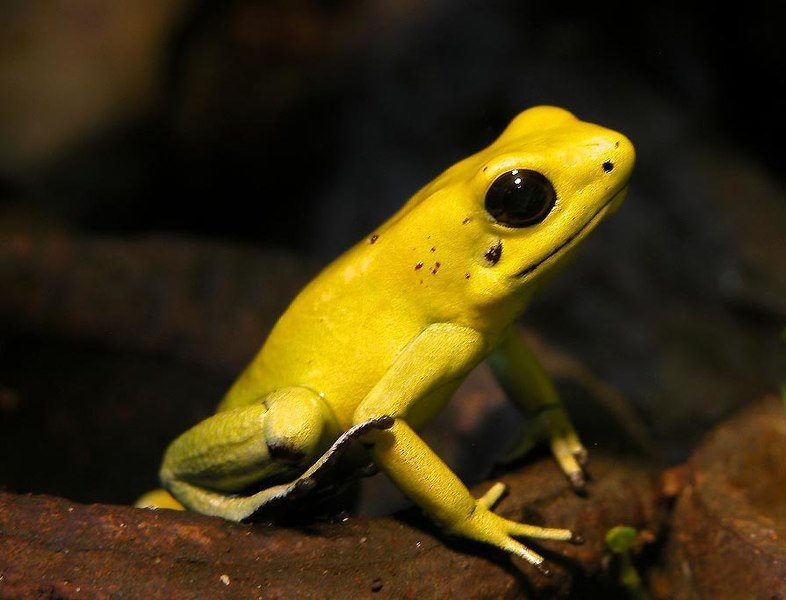
3. Golden poison dart frog


Golden poison dart frog.


Considered to be one of the most toxic animals, the bright yellow color of the Golden poison dart frog serves as a warning to its powerful poison. They live mainly within a tiny plot of rain forest on the Pacific coast of Colombia. These frogs are 2 inches (5 cm). These brightly colored amphibians are among the largest of the more than 100 poison dart frog species, averaging more than one inch (two and a half centimeters) in length.

Golden poison dart frogs are not poisonous in captivity because they get there poison from what they eat. It is possible they assimilate plant poisons, which are carried by their prey. Their diet includes flies, crickets, ants, termites, and beetles.

Their powerful poison (along with the poison dart frogs) was used on blow darts by indigenous people.

The medical research community has been exploring possible medicinal uses for the golden poison dart frog's venom. They have already developed a synthetic version of one of the venom's compounds that has promise as a powerful painkiller.

Sources:
Wikipedia
National Geographic

Tuesday, 10 February 2009

Biology: 5 Frogs

2. Goliath Frog


The goliath frog is the largest extant (the opposite of extinct, so "living") frog on earth. It grows up to 16 inches or 33 cm long from nose to vent, Length with legs stretched out its about 2.5 feet (76.2 cm). It weighs up to 8 lb (3 kg). On top, the frog is greenish brown, and its underside is yellowish

The Goliath frog is normally found in fast-flowing rivers with sandy bottoms in the West African countries of Cameroon and Equatorial Guinea. These rivers are usually clear and highly oxygenated. The river systems in which these frogs live are often found in dense, extremely humid areas with relatively high temperatures.

Adults are carnivores that eat insects, crustaceans, fish, and amphibians. Tadpoles (baby frogs) are herbivores that eat water plants found only near waterfalls and in rapids.

The Goliath frog can live up to 15 years.

These frogs have acute hearing but no vocal sac,thus, they can not make sounds.

Goliath frogs were considered to be a source of food in some parts of west Africa.

They are endangered.

Sources:
Wikipedia
www.pocanticohills.org
Photo: marginalia.ako.net.nz

Tuesday, 27 January 2009

Biology: 5 Frogs

1. Australian Green Tree Frog


Australian Green Tree Frog on branch.


Also called the White's Tree Frog and the Dumpy Tree Frog the Australian Green Tree Frog is the species Litoria caerulea of the family Hylidae. It is native to Australia and New Guinea and was introduced to New Zealand and the United States. They are called White's Tree Frogs in honour of John White who first made a discrption of them in 1790.

The species was originally called the "blue frog" (Rana caerulea) despite its green colour. The original specimens White sent to England were damaged by the preservative and appeared blue.

The adult frogs can grow to 4-5 inches in length. Females are usually longer than males, but it is very difficult to determine sex, even when the frog is a bit older. The frogs are calm by nature and not very active. They are nocturnal and come out in early evenings to call (in spring and summer) and hunt at night. During the day they find cool, dark, and moist areas to sleep. During winter, Green Tree Frogs do not call and are not usually seen.

Depending on their location, Green Tree Frogs occupy various habitats. Typically, they are found in the canopy of trees near a still-water source. However, they can survive in swamps (among the reeds) or in grasslands in cooler climates. Green Tree Frogs are well known for inhabiting water sources inside houses, such as sinks or toilets. They can also be found on windows eating insects. They will occupy tanks (cisterns), downpipes (downspouts), and gutters, as these have a high humidity and are usually cooler than the external environment. The frogs are drawn to downpipes and tanks during mating season, as the fixtures amplify their call.

The species has an average life expectancy in captivity of sixteen years, but some have been known to live for over twenty years, which is long for a frog. The average life expectancy in the wild is lower than in captivity, due to predation.

Sources:
whitestreefrog.net
Wikipedia

Followers

About This Blog

I am a grade nine student living in Mexico. This is my home school education blog. I post the things I learned during the week on this blog. I hope you can learn things from this too.


  © Blogger template 'Photoblog II' by Ourblogtemplates.com 2008

Back to TOP