Labels


Monday, 23 August 2010

Poem: Rhyming Poem

Winter in the woods.

In the wood of snow-covered willows,
We lay in the snow like a bed full of pillows.
We wish we could stay there all day and all night,
we play in the snow with no need for fright.

Poem: Carpe Diem

Chance to fill a day.

You have one chance to fill a day.
Even though move by it may,
try to fill it with work and play.
There's only one chance to fill a day.

Poem: ABC

All days can be fun,
Because were alive.
Can you enjoy them?
Do you even try?

Monday, 9 August 2010

3 Poems

1. The Road Not Taken by Robert Frost

TWO roads diverged in a yellow wood,
And sorry I could not travel both
And be one traveler, long I stood
And looked down one as far as I could
To where it bent in the undergrowth;
Then took the other, as just as fair,
And having perhaps the better claim,
Because it was grassy and wanted wear;
Though as for that the passing there
Had worn them really about the same,
And both that morning equally lay
In leaves no step had trodden black.
Oh, I kept the first for another day!
Yet knowing how way leads on to way,
I doubted if I should ever come back.
I shall be telling this with a sigh
Somewhere ages and ages hence:
Two roads diverged in a wood, and I—
I took the one less traveled by,
And that has made all the difference.


This was my favorite poem of the three. I particularly liked how the poem managed to have a serious tone yet still rhyme. Though this was the first poem I had read with the this rhythm. The first line in each stanza rhymes with the third and fourth lines, and the second line rhymes with the fifth. I found this very interesting.

I think the poem is talking about life, and how each decision we make or life course we take is like a fork in a road. Each choice can completely change our direction in life.

2. Messy Room by Shel Silverstein

Whosever room this is should be ashamed!
His underwear is hanging on the lamp.
His raincoat is there in the overstuffed chair,
And the chair is becoming quite mucky and damp.
His workbook is wedged in the window,
His sweater's been thrown on the floor.
His scarf and one ski are beneath the TV,
And his pants have been carelessly hung on the door.
His books are all jammed in the closet,
His vest has been left in the hall.
A lizard named Ed is asleep in his bed,
And his smelly old sock has been stuck to the wall.
Whosever room this is should be ashamed!
Donald or Robert or Willie or--
Huh? You say it's mine? Oh, dear,
I knew it looked familiar!

This poem is more of a joke than something emotional. It is told by a person who walks into a room, sees what a mess it is, and starts criticizing the owner, only to find its his room.

I think this shows a human tendency to assign blame to others rather than accept ourselves as the source of the problem.

3. Brown Penny by William Butler Yeats

I WHISPERED, 'I am too young,'
And then, 'I am old enough';
Wherefore I threw a penny
To find out if I might love.
'Go and love, go and love, young man,
If the lady be young and fair.'
Ah, penny, brown penny, brown penny,
I am looped in the loops of her hair.
O love is the crooked thing,
There is nobody wise enough
To find out all that is in it,
For he would be thinking of love
Till the stars had run away
And the shadows eaten the moon.
Ah, penny, brown penny, brown penny,
One cannot begin it too soon.


This is a love poem. Not about someone but love itself. It tells of a young man who is contemplating whether to find love. It then talks about how complex and "crooked" love is. It ends by saying "One cannot begin it too soon."

I think the poem is saying love should not be planned.


Tuesday, 8 June 2010

Biology: Blue Desert


Whitsunday Islands.


When you see the image above, "desert" is probably the last word that comes to mind. Tropical waters are warm, clear and full of life right?

Wrong. In general tropical waters, near the equator, have less marine life than the colder temperate waters to the north and south. Here is why.

Seasons create differences in temperature throughout the year. These temperature changes cause the deep and surface water to mix. The mixing brings nutrients to the surface allowing phytoplankton to grow. This phytoplankton, being at the bottom of the food chain, feeds the rest of the food chain.With out it most marine life can't survive.

The the problem with the tropics is that with out distinguished seasons the surface water and the deep water don't mix. Without any nutrients left in the surface water, all the nutrients lie bellow 492 feet (150 m) to a depth too dark for phytoplankton to grow, leaving most of the tropical waters with less life then temperate waters.

Coastal upwellings and coral reefs act as oases in the vast blue desert. Coral reefs accumulate and recycle nutrients and in coastal upwellings deep seawater moves up to the surface.

Sources: Oceans: A Visual Guide by Stephen Hutchinson and Lawrence E. Hawkins
Photo: Wikipedia

Monday, 7 June 2010

Social Studies: Camp X


Monument of Camp X in Ontario, Canada.


Officially called S 25-1-1 by the Royal Canadian Mounted Police (RCMP), Project-J by the Canadian military, and Special Training School 103 by the Special Operations Executive, a branch of the British intelligence service MI6.Camp X was a Second World War paramilitary and commando training installation near lake Ontario in Canada.

Camp X trained over five hundred Allied units of which 273 of these graduated and moved on to London for further training. They were trained in special techniques including silent killing, sabotage, partisan support and recruitment methods for resistance movements, demolition, map reading, use of various weapons, and Morse code.

Writer Roald Dahl and supposedly Ian Flemming were trained at there.

Records pertaining to Camp X were either locked away under the Official Secrets Act or destroyed after World War II.

Sources: Wikipedia

Monday, 17 May 2010

Social Studies: Canadian Pacific Railway


The last spike being driven by Donald Smith, later known as Lord Strathcona.


Canadian Pacific Railway is a historic Canadian Class I railway founded in 1881 and now operated by Canadian Pacific Railway Limited which began operations as legal owner in a corporate restructuring in 2001.

The Conservative government of Prime Minister Sir John A. Macdonald. British Columbia had insisted upon a transport link to the east as a condition for joining the Confederation of Canada.

The Canadian Pacific Railway began its westward expansion from Bonfield, Ontario and on November 7, 1885, the Last Spike was driven at Craigellachie, British Columbia. It was by far the longest railway ever constructed at the time. It had taken 12,000 men, 5,000 horses, and 300 dog-sled teams to build the railway.

Sources: Wikipedia

Tuesday, 27 April 2010

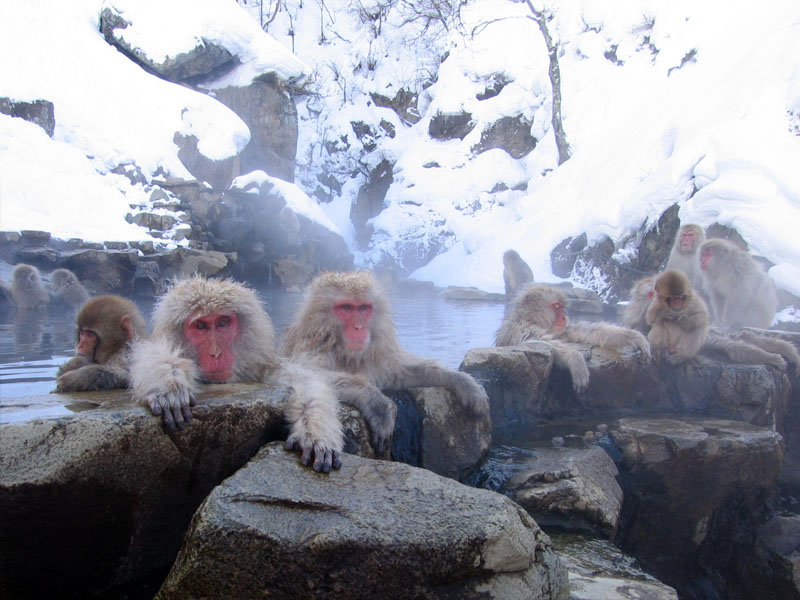
Biology: Japanese Macaque


The Japanese Macaque lives in mountainous areas of Honshū, Japan. It survives winter temperatures below -15 °C (5°F), and is perhaps most notable for the amount of time it spends in naturally heated volcanic hot springs. It has a body length ranging from 79 to 95 cm, with a tail length of approximately 10 cm.

It feeds on seeds, roots, buds, fruit, invertebrates, berries, leaves, eggs, fungi, bark, cereals and in rare cases even fish. The Japanese Macaque is a very intelligent species. It is the only animal other than humans and raccoons that is known to wash its food before eating it. The macaque has other unusual behaviors, including bathing together in hot springs and rolling snowballs for fun.

Did you know?

In recent studies it has been found that the Japanese Macaque can develop different accents, like humans.

Sources: Wikipedia

Tuesday, 13 April 2010

Biology: Fastest Animals

Fastest running animal: Cheetah.

  • Latin name: Acinonyx jubatus.
  • Speed: Between 112 and 120 km/h (70 and 75 mph). It can go from 0 to 103 km/h (64 mph) in three seconds.
  • Info: Cheetahs like to live in wide open spaces like grasslands, though they can be found in a variety of locations. The cheetah is a carnivore, eating mostly mammals under 40 kg (88 lb), including the Thomson's Gazelle, the Grant's gazelle, the springbok and the impala. The cheetah hunts by vision rather than by scent.
Sources: Wikipedia

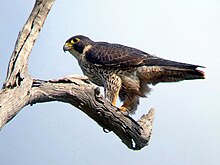
Fastest flying animal: Peregrine Falcon
  • Latin name: Falco peregrinus
  • Speed: 200 mph (320 km/h).
  • Info: The Peregrine falcon is a formidable predator. Worldwide it is estimated to prey on 1500 - 2000 bird species. Those that nest on Arctic tundra and winter in South America fly as many as 15,500 miles (25,000 kilometers) in a year.
Sources: Wikipedia, National Geographic

Fastest swimming animal: Sailfish

Latin name: Istiophorus Platypterus

Speed: 68 mph (110 km/h)

Info: The two main subspecies of sailfish, Atlantic and Indo-Pacific, range throughout the warm and temperate parts of the world’s oceans. They feed on schools of smaller fish like sardines and anchovies.

Sources: National Geographic

Monday, 12 April 2010

Social Studies: What kind of name is that?

I've wondered why countries aren't pronounced or even named in their native language.

Here are some examples:

English: Japan
Japanese (English characters): Nihon-koku

English: Hungary
Hungarian:
Magyarország

En
glish: Egypt
Arabic:
Miṣr or Egyptian: Kemet

I know from learning languages there are difficulties in pronunciation but they could make it somewhat similar.

Sources: Wikipedia (Japan, Hungary, Egypt).

Tuesday, 30 March 2010

Biology: True or False?

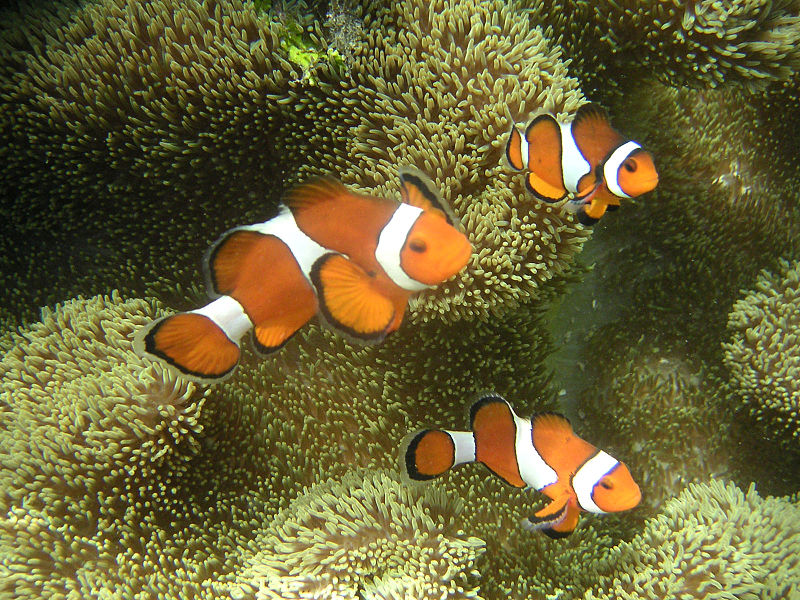
What is the difference between the True Percula Clownfish (Amphiprion percula) and the False Percula Clownfish (Amphiprion ocellaris)?

These two species are very similar but have subtle differences. The most reliable is that the True Percula Clownfish has ten spines on its first dorsal fin (the fin on top of its body closest to its head.) and the False Percula Clownfish has 11.

I believe this fits into the category of useless information. But, who knows, it may come in handy in a trivia game.


True


False


Sources: Wikipedia

Tuesday, 23 March 2010

Biology: Hippo and Tortoise

This is the story of a hippopotamus named Owen and a giant tortoise named Mzee.

Just before Christmas the unseasonably heavy rains near Malindi, Kenya washed a family of hippopotamuses down the near by Sabaki River and out to sea. The residents of the town tried in vain to urge the family back up the estuary. When a Tsunami hit Malindi the hippos disappeared and were forgotten as all efforts went to rescuing the stranded fishermen.

The next day only a stranded baby hippo could be seen.With ropes, boats, nets and cars the hippo was captured and provided a home by Lafarge Eco Systems. The hippo was named 'Owen' in honor of the volunteer who tackled him to the ground. Exhausted, confused and extremely frightened, Owen immediately ran to the safety of a giant tortoise when we released him in Haller Park.

The tortoise, named Mzee, was 130 years old. Mzee quickly came to terms with his new friend and even returned signs of affection. The unusual relationship between this baby hippo and the ancient tortoise amazed people the world over and has featured in most countries on television and in news papers.

Owen will eventually be moved to a bigger pond in Haller Park were he can socialize with other hippos.

Sources: npr.org

Monday, 22 March 2010

Social Studies: Champagne


Champagne aging in a cellar.


Champagne is a sparkling wine from the Champagne region of France. The primary grapes used in the production of Champagne are Chardonnay, Pinot noir and Pinot Meunier.

The Champagne region is not ideal for making red wine. Grapes would struggle to ripen fully and often would have bracing levels of acidity and low sugar levels. Furthermore, the cold winter temperatures prematurely halted fermentation in the cellars, leaving dormant yeast cells that would awaken in the warmth of spring and start fermenting again. One of the byproducts of fermentation is the release of carbon dioxide gas, which, if the wine is bottled, is trapped inside the wine, causing intense pressure. The pressure inside the weak, early French wine bottles often caused the bottles to explode, creating havoc in the cellars.

If the bottle survived, the wine was found to contain bubbles, something that the early winemakers were horrified to see, considering it a fault. As late as the 17th century, Champenois wine makers, most notably the Benedictine monk Dom Pérignon (1638–1715), were still trying to rid their wines of the bubbles.

The English were one of the first who saw the tendency of Champagne to sparkle as a desirable trait, and tried to understand why it did bubble. In 1662, the English scientist Christopher Merret presented a paper detailing how the presence of sugar in a wine led to it eventually sparkling, and that nearly any wine could be made to sparkle by adding sugar to a wine before bottling it.

Champagne continued to gain popularity until the early 20th century when riots, the phylloxera insect, hailstorms, flooding and the two World Wars affected the Champagne industry.

After World War II the popularity surged again in the 1950s. Champagne is still popular at special events and celebrations.

Did you know?

The Journal of Agricultural and Food Chemistry published the results of a recent joint study by the University of Reading and University of Cagliari that showed moderate consumptions of Champagne may help the brain cope with the trauma of stroke, Alzheimer's, and Parkinson's disease.

Sources: Wikipedia

Friday, 26 February 2010

Picture Blog: The not so wild west.


Rodeo? I don't think so. But it's still a pretty cool pic.

By the way the tortoise is a Aldabra Giant Tortoise.

Source: Wikipedia

Tuesday, 23 February 2010

Science: El Niño


The El Niño weather disturbance happens about 30 times per century, taking place in the South Pacific. They affect weather around the globe. But to understand El Niño we must first know the normal weather patterns in the South Pacific.

  • Normally, a low pressure system in the southwest Pacific draws air from a high pressure system the southeast Pacific creating southeast trade winds. These pressure systems are caused by warm air rising the west, moving east and descending over South America. The low pressure systems near Australia and Oceania create rainy conditions.
  • The trade winds create the South Equatorial Current, which move warm surface water westward where it pools near Australia and Oceania.
  • As the surface water is blown away from from South America cold nutrient rich water rises from the deep to take its place. This nutrient rich water supports a food chain and a local fishing economy.
But, during an El Niño year, for reasons still unknown, the cycle slows or even reverses. (See diagram above.)

El Niño causes floods, droughts and storms around the world.

Note: El Niño is a complex but interesting subject, I do recommend doing more research.

Sources:
Book: Ocean by The American Museum of Natural History.
Book: Oceans: A Visual Guide by Stephen Hutchinson and Lawrence E. Hawkins

Diagram: Mark Dowe's Journal

Monday, 22 February 2010

Social Studies: Caribbean Colonizattion


Map of Caribbean, 1843.


After Christopher Columbus' voyages most of the Caribbean was owned by Spain. The region was originally called the West Indies because when Christopher Columbus landed here in 1492 he believed that he had reached the Indies Mountains in Asia.

The Spanish found out that their was gold when they found small amounts in the personal ornaments of the native population. The Spanish, who came seeking wealth, enslaved the native population and rapidly drove them to near-extinction . They then imported African slaves.

The Portuguese and Spanish colonies were bringing in gold and other countries, like England, the Netherlands, and France, wanted to start their own profitable colonies. The many colonies in the Caribbean led to many European wars throughout the centuries.

In the 19th and 20th centuries a number of colonies gained independence from the European powers, some examples are Haiti, Saint-Domingue and Cuba.

Sources: Wikipedia

Friday, 19 February 2010

Science - Lava Flows

When magma from inside the Earth is expelled from volcanoes it's a liquid, so it flows quite a distance before it cools and hardens. There are three basic types of lava.

Pahoehoe lava (above) is hotter and more fluid than the other types of lava, Aʻā and Pillow Lava. Pahoehoe lava is is typically 1100 to 1200 °C. Pahoehoe lava flows are shinny and wrinkled.

Aʻā lava (below) is liquid lava surround by a layer of hard rock chunks called clinker. Aʻā lava is cooler at 1000 to 1100 °C, and moves slower than pahoehoe lava.


The lava flows shown are in Hawaii; The volcanoes in Hawaii are called shield volcanoes because the swirling lava resemble ancient battle shields.

Pillow lava is lava that emerges underwater or under glaciers. It is named after its pillow or bubble like form. Since water covers the majority of Earth's surface and most volcanoes are situated near or under bodies of water, pillow lava is very common.

Sources: National Geographic
Wikipedia

Tuesday, 16 February 2010

Biology: Leafy Sea Dragon


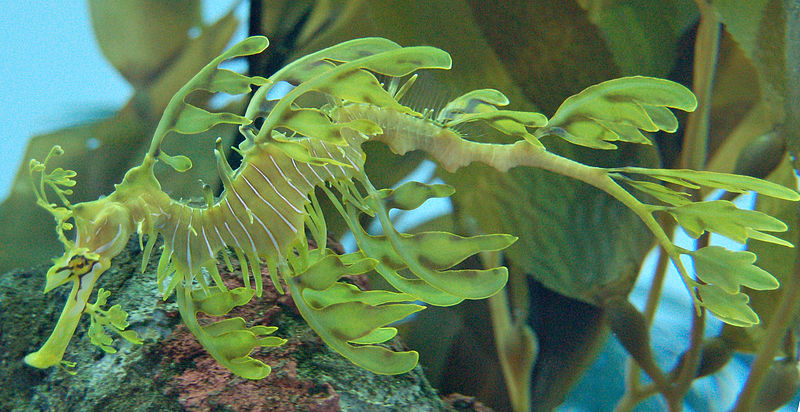
The leafy sea dragon is named for its resemblance to a floating piece of seaweed and a dragon.


The lobes of skin that grow on the leafy sea dragon give it the appearance of seaweed, allowing it to camouflage with its surroundings. Its leafy appearance also enables it to appear to move through the water like a piece of floating seaweed.The leafy sea dragon propels itself by means of a pectoral fin on the ridge of its neck and a dorsal fin on its back closer to the tail end.

It primarily eats crustaceans including plankton and mysids, but its diet also includes shrimp and small fish. Leafy sea dragons oddly enough do not have teeth, which is rare amongst animals that eat small fish and shrimp.

The leafy sea dragon is found only in the waters of Australia.

Sources: Wikipedia

Monday, 15 February 2010

Social Studies: Mykonos Windmills


Mostly built by Venetians in the 16 century, the Mykonos Windmills were an innovative way to utilize the gusty wind that blows across Mykonos island in Greece.

Mykonos was a major seaport between Venice and Asia. The need to refine grain was high and the strong winds of Mykonos made it an ideal spot for windmills. All of the windmills look similar, being white and round with a pointed roof. The windmills were of great importance, but because modernization they are no longer operational. The last windmill operated until the 1960s. Today, seven of the windmills have been preserved out of ten (once there were more than twenty on the island).

Sources:
greeka.com
MykonosTour.com
Wikipedia

Photo:
Wikimedia Commons

Friday, 12 February 2010

Social Studies: SS Nornen Wreck


The shipwreck in Somerset, England.


The ship ran aground (hit the shore) on March 3, 1897.

Sources: Wikipedia

Followers

About This Blog

I am a grade nine student living in Mexico. This is my home school education blog. I post the things I learned during the week on this blog. I hope you can learn things from this too.


  © Blogger template 'Photoblog II' by Ourblogtemplates.com 2008

Back to TOP