Labels


Showing posts with label Physics. Show all posts

Friday, 17 April 2009

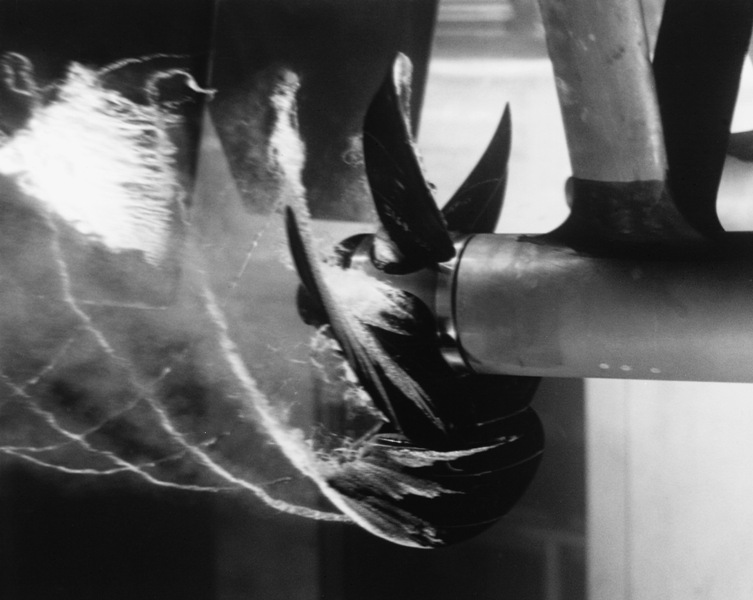
Physics: Cavitation

Cavitation is when vapor bubbles form in a liquid when the liquid pressure drops below the vapor pressure.

Cavitation can occur on ship and submarine propellers. Because the faster a fluid move the less pressure it has. The water moving past the propeller can reach pressures bellow the vapor pressure and cavitation occurs.

Just as cavitation bubbles form on a fast-spinning boat propeller, they may also form on the tails and fins of aquatic animals. The effects of cavitation are especially important near the surface of the ocean, where the ambient water pressure is relatively low and cavitation is more likely to occur.

For powerful swimming animals like dolphins and tuna, cavitation may be detrimental, because it limits their maximum swimming speed. Even if they have the power to swim faster, dolphins may have to restrict their speed because collapsing cavitation bubbles on their tail are too painful. Cavitation also slows tuna, but for a different reason. Unlike dolphins, these fish do not feel the painful bubbles, because they have bony fins without nerve endings. Nevertheless, they cannot swim faster because the cavitation bubbles create an air film around their fins that limits their speed. Lesions have been found on tuna that are consistent with cavitation damage.

Sources: Wikipedia

Thursday, 12 March 2009

Physics: Acceleration

Getting acceleration (like speed) requires division.

a = v / t is an equation for finding acceleration. It means: a (acceleration) is is found by dividing the v (velocity or speed) by the time it takes.

Say your going 65 km/h on a flat road, then suddenly an animal runs onto the road. You hit the breaks and it takes you 15 seconds to come to a complete stop: 0 km/h. What was your deceleration.
2
You don't want a number less than 1 so you decide to put it cm/sec *.

First, convert km/h to km/s by dividing it by 60 because there are 60 minuets in an hour to get: 1.08. Then divide that by 60 because there are 60 seconds in a minute to get: 0.01.

Next, multiply that by 1000 to get m/s and then by 100 to get cm/s: 1805.5.
2
Finally, divide that by 15 to get -120.3** cm/s.
2
That's that. The deceleration is -120.3 cm/s.


*The act of dividing velocity by time makes the denominator squared.
**It is negative because the speed is decreasing.

Sources:
Physics workbook for dummies.

Thursday, 5 March 2009

Physics: Your Speed


Say you're on a road trip that is 2000 km (this equation applies to any unit of distance: feet, meters, miles, ext.) and it took you 2 days. But you want to know your average speed in km/h.

The equation is v=s/t. Basically velocity (v) is equal to the distance (s) divided by the time (t) it took.

In this case the distance was 2000 km over a time over time of 2 days.

So your speed is 2000 km/2 days, to make it km/h you need to divide.

First, divide 2000 by 2 to get 1000 km per day.

Second, divide 1000 by 24 (because there are about 24 hours in a day) to get 41.6.

So you average speed on the road trip was 41.6 km/h.

Wednesday, 7 January 2009

Physics: Physics

Physics is basically the study of the natural world and how it works and behaves. It examines basic concepts such as energy, force, and spacetime and all that derives from these, such as mass, charge, matter and its motion.

Physics is both significant and influential, in part because advances in its understanding have often translated into new technologies, but also because new ideas in physics often resonate with the other sciences, mathematics and philosophy. For example, advances in the understanding of electromagnetism led directly to the development of new products which have dramatically transformed modern-day society (e.g., television, computers, and domestic appliances).

Early physical theories were largely couched in philosophical terms, and never verified by systematic experimental testing as is popular today. One great mystery was the predictable behavior of celestial objects such as the Sun and the Moon. The laws of physics are seen in simple machines which work together in complex machines.

Sources: Wikipedia

Thursday, 18 December 2008

Physics: CGI System


The CGI (centimetre-gram-second) sytem:

Unit, Measurement, Abbreviation
centimeter, length, cm
gram, mass, g
second, time, s
dyne, force, dyne
erg, energy, erg
barye, pressure, ba
biot, electric currant, Bi
gauss, magnetism, G
frankin, electric charge, Fr

Sources: Physics for dummies

Followers

About This Blog

I am a grade nine student living in Mexico. This is my home school education blog. I post the things I learned during the week on this blog. I hope you can learn things from this too.


  © Blogger template 'Photoblog II' by Ourblogtemplates.com 2008

Back to TOP