Labels


Showing posts with label Chemistry. Show all posts

Monday, 4 January 2010

Chemistry: Plastic From Milk?

You can extract a plastic like material called casein from milk.

You will need:

  • Milk
  • Spoon
  • Vinegar
  • Pot
  • Jar
  • Strainer
  • Paper towel

1. Heat an 8-ounce (240 ml) cup of milk on a stove but don't let it boil.

2. Add 1 tablespoon of vinegar and stir.

3. Pour through a strainer into a jar to remove solid clumps that appear.

4. Use a spoon to squeeze out the liquid.

5. Place on and dab with paper towel to remove excess moisture.

6. Mold into wanted shape and let dry for 1 - 2 days.

Monday, 7 September 2009

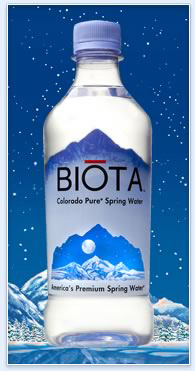
Chemestry: Biota Sping Water

This mat seem to be like any other bottle of water. But, the amazing thing about it is... it's made from corn. Given the right composting conditions including high heat, humidity and micro-organisms, a BIOTA bottle will disappear in 75 to 80 days...basically 12 weeks.

Here is the website: http://www.biotaspringwater.com/

Wednesday, 2 September 2009

Chemestry: Temperatures

Candle flame: 1000 °C (1832 °F)

−273.15° C (−459.67° F) Absolute zero the coldest temperature theoretically possible.


> −210 °C ( −346 °F) Freezing point of liquid nitrogen.


> −196 °C (−321 °F ) Boiling point of liquid nitrogen.


> −140 °C (−220 °F) Polar winter on mars. > −89.2°C (−128.6°F) Coldest recorded temperature on earth. Antartica


> −78.5 °C (−109.3 °F) Sublimation point of dry ice.* -38.83 °C, (-37.89 °F) Melting point of mercury.


> 0° C (32°F) Freezing point of water. 36.8° C (98.2 °F) Average human body temperature


> 58° C (136° F ) Hottest recorded temperature on earth. Lybia


> 99.9839° C (211.97102° F) Water boils at standard pressure.


> 327.46 °C (621.43 °F) Melting point of lead.


> 660.32 °C, (1220.58 °F) Melting point of aluminum


> 1000 °C (1832 °F) Candle flame


> 1300 °C (2372 °F) Blowtorch flame


>3642 °C (6588 °F) Sublimation point of carbon.


> 5526°C 9980°F Surface of the Sun.


* Sublimation in when a solid turns into a gas without turning into a liquid.

Sources: Wikipedia

Wednesday, 27 May 2009

Chemestry: Electroplating

Electroplating is using electrical current to coat a metal with a thin layer of another metal.

The anode and cathode in the electroplating cell are both connected to an external supply of direct current - a battery or, more commonly, a rectifier. The anode is connected to the positive terminal of the supply, and the cathode (article to be plated) is connected to the negative terminal. When the external power supply is switched on, the metal at the anode is oxidized from the zero valence state to form cations with a positive charge.

These cations associate with the anions (with a negative charge) in the solution. The cations are reduced at the cathode to deposit in the metallic, zero valence state. The build up of these atoms create a thin layer.

Sources: Wikipedia

Wednesday, 6 May 2009

Chemistry: Branched Molecules

2-methyl-4-ethylhexane? What is this? It is a molecules with two branches. It looks like this:
To figure out why it is named this, we must (as in the Alkane Names blog) find, the longest continuous chain of carbon atoms, which is 6 thats hex. That explains the hexane at the end.

But what about the methyl and the ethyl. Those have to do with the branches (the carbon chains connected to the hexane). Lets start with the branch with one carbon atom 1 = meth and all 'branches end in yl. So that,s methyl.

The same applies to the branch with to atoms, 2 = eth, ethyl.

How do you explain the numbers? That is it what atom the branch is conected two in relation to the edge. But, you would get to two numbers, methyl could be connected two 5 or 2.

You always chose the end closest to the branch. In this case the right end: 2. That gives you 2-*methyl. Use the same edge with ethyl: 4. That's 4-ehtyl.

All together: 2-methyl-4-ethylhexane.

*Separate letters and numbers with hyphens -.

Sources: Yotube (these are cool videos)

Wednesday, 22 April 2009

Chemistry: Alkane names


???

What is this mystery molecule. How do we figure out the names of alkanes like the one above?

Simply count the number of carbon atoms in a row.

Here are the names from 1 - 10

Meth - 1
Eth -2
Prop - 3 (as in propane)
But - 4 (as in butane)
Pent -5
Hex - 6
Hept - 7
Oct - 8
Non - 9
Dec -10

It has 8 carbon atoms so go to 8 that's "oct". All alkanes end in "ane" so the molecule is octane.

Or think of it this way: just take the "alk" out of alkane and replace it with "oct" to get octane.

Sources: Wkipedia
Youtube

Wednesday, 15 April 2009

Chemistry: NFPA 704


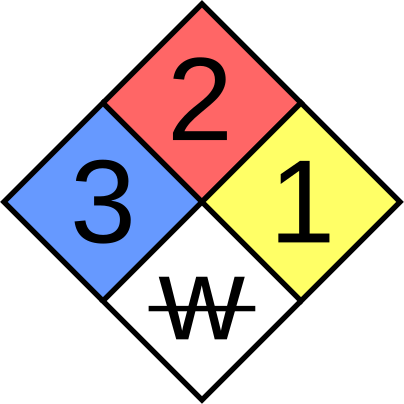
If you have ever seen or worked with chemicals you've probably seen one of these. This is a NFPA 704 or "fire diamond". NFPA stands for National Fire Protection Association. The "fire diamond" used by emergency personnel to quickly and easily identify the risks posed by nearby hazardous materials

This is what it means:

Blue: Health
0 - Poses no health hazard, no precautions necessary.
1 - Exposure would cause irritation with only minor residual injury
2 - Intense or continued but not chronic exposure could cause temporary incapacitation or possible residual injury
3 - Short exposure could cause serious temporary or moderate residual injury
4 - Very short exposure could cause death or major residual injury

Red: Flammability
0 - Will not burn.
1 - Must be heated before it can ignite.
2 - Must be moderately heated or exposed to relatively high ambient temperature before ignition can occur.
3 - Liquids and solids that can be ignited under almost all ambient temperature conditions.
4 - Is readily dispersed in air and will burn readily.

Yellow: Instability/Reactivity
0 - Normally stable, even under fire exposure conditions, and is not reactive with water.
1 - Normally stable, (but can become unstable at elevated temperatures and pressures).
2 - Undergoes violent chemical change at elevated temperatures and pressures, reacts violently with water, or may form explosive mixtures with water.
3 - Capable of detonation or explosive decomposition but requires a strong initiating source, must be heated under confinement before initiation, reacts explosively with water, or will detonate if severely shocked.
4 - Readily capable of detonation or explosive decomposition at normal temperatures and pressures.

The white diamond is something that makes the compound especially dangerous. In this case the compound reacts with water.

Sources:
Wikipedia
Wikimedia Commons

Wednesday, 25 March 2009

Chemistry: Electron Configuration

Atoms have layers of electron shells the amount of electrons in each shell, from innermost to outermost shell is written, as an electron configuration.

There are two ways to write electron configurations in the full from or the condensed form.

Each shell or "orbital" has a certain amount of electrons it can hold and are divided into lettered sections: s which can hold 2 electrons, p which can hold 6 electrons, d which can hold 10 electrons and f orbitals which can hold 14 electrons. The shells are filled in this order:

1s, 2s, 2p, 3s, 3p, 4s, 3d, 4p, 5s, 4d, 5p, 4f, 5d.

This is the Aufbau principle.

Lets do chlorine as an example.

Chlorine has an atomic number of 17 which means it has 17 electrons.

First we fill the 1s orbital which in now 1s2 (normally the number of electrons would be by the top), we now have 15 more electrons left put in shells.

Then we fill 2s making it 2 leaving 13 electrons left.

Then we fill 2p making it 2p6 , because p orbitals hold 6 electron.

Then we fill 3s make it 3s2 we now have 5 left leaving 3p with only 5 electrons: 3p5.

So the full form is: 1s2, 2s2, 2p6 , 3s2 , 3p5.


To get the condensed form go back to the last noble gas, which in this case is neon. The orbitals of neon (1s2, 2s2, 2p6 ) are the first three of chlorine 1s2, 2s2, 2p6 , 3s2 , 3p5. So the first three orbital can be abbreviated to [Ne], then add the two extra orbitals from chlorine to get [Ne] 3s2 , 3p5.

That's the condensed version.

Sources: Chemistry Workbook for Dummies.

Wednesday, 25 February 2009

Chemistry: Carbon fiber


Carbon fiber (running from lower left to upper right) and a human hair.


Carbon fiber is a material consisting of extremely thin fibers composed mostly of carbon atoms. The carbon atoms are bonded together in microscopic crystals which form a single strand, several thousand of these strands form a yarn, which is woven to make a fiber.

Carbon fiber is usually put n plastic to make carbon fiber reinforced plastic. This is used in sports, electronics and some toys.

Carbon fiber can be made from heating PAN (polyacrylonitrile) to approximately 300°C (572 ºF) which breaks many of the hydrogen bonds and oxidizes the material. The oxidized PAN is then placed into a furnace having an inert atmosphere of a gas such as argon, and heated to approximately 2000 °C (3632 ºF) which changes the structure of the molecules. The result is usually 93-95% carbon.

Sources:
Wikipedia

Wednesday, 11 February 2009

Chemistry: Why atoms react.

Scientists picture atoms as having layer of shells, each containing electrons. The outer most shell .controls reaction. Atoms tend to want four or eight electrons in their outermost shell. The farther away from this goal the atom is the more it reacts.

Sources:
Popular Science Almanac For Kids.
Chemistry Workbook For Dummies.

Wednesday, 28 January 2009

Chemistry: Temperature Convertions


To convert from Kelvin to Celsius:

Kelvin = Celsius - 273 (The freezing point of water is therefore a balmy 273 Kelvin (K).)

In contrast to the Kelvin scale, the Celsius scale sets its zero at the freezing point of water.
Aside from that shift in zero-point, the two scales are identical. The size of a Celsius degree is
exactly equal to the size of a Kelvin degree.

At absolute zero, all elements are solids. At all temperatures greater than about 6,000K, all
elements are gaseous.

Sources: Picture credit...
Book: Chemistry Workbook For Dummies

Monday, 12 January 2009

Chemistry: How many Neutrons?


M = P + N

That equation can be used to find the number neutrons in an atom if you only know the atomic mass (the mass of the atom) and the number of protons.

The equations means:

M (mass) = P (protons) + N (neutrons)

So if you add the number of protons and Neutrons you get most of the mass.

The number of protons and electron are the same.

Electrons take up very little mass they are almost 2000 times less (1836 time less to be exact) mass than protons or neurons.

M = P + N can also be used to find the number of neutrons for example potassium has an atomic mass of 39.1 and 19 protons.

39.1 - 19 = 20.1 There are about 20 neutrons in a potassium atom.

Chemistry for Dummies
www.eskom.co.za

Wednesday, 17 December 2008

Chemistry: Tungsten


Tungsten filament in halogen lamp.


Color: greyish white, lustrous

Tungsten has the highest melting point, which is 3695 K (3422 °C, 6192 °F), and lowest vapour pressure of all metals, and at temperatures over 1650°C has the highest tensile strength.

The name Tungsten comes from the Swedish tung sten, meaning "heavy stone".

In its raw form, tungsten is a steel-gray metal that is often brittle and hard to work. But, if pure, it can be worked easily. Elemental tungsten resists attack by oxygen, acids, and alkalis.

Tungsten is found in the minerals wolframite, scheelite, ferberite and hübnerite. These are mined and used to produce about 37,400 tons of tungsten concentrates per year in 2000.Over 75% of this production came from China, while most of the remaining production is done in Austria, Bolivia, Portugal, and Russia.

Tungsten has many uses some are:

  • light bulb filaments
  • cathode-ray tube filaments
  • vacuum tube filaments
  • heating elements
  • rocket engine nozzles
  • electrodes
  • electron microscopes
  • plastic composite filler
  • glass-to-metal seals
  • turbine blades
  • darts
  • weights for fishing lures
  • cannon shells (to create supersonic shrapnel)
  • grenades (to create supersonic shrapnel)
  • missiles (to create supersonic shrapnel)
  • wear-resistant abrasives
  • cutters and knives for drills, circular saws, milling and turning tools.
Tungsten is sometimes a substitute for gold for durability.

Sources:
Wikipedia
webelements.com

Wednesday, 10 December 2008

Chemistry: Beer


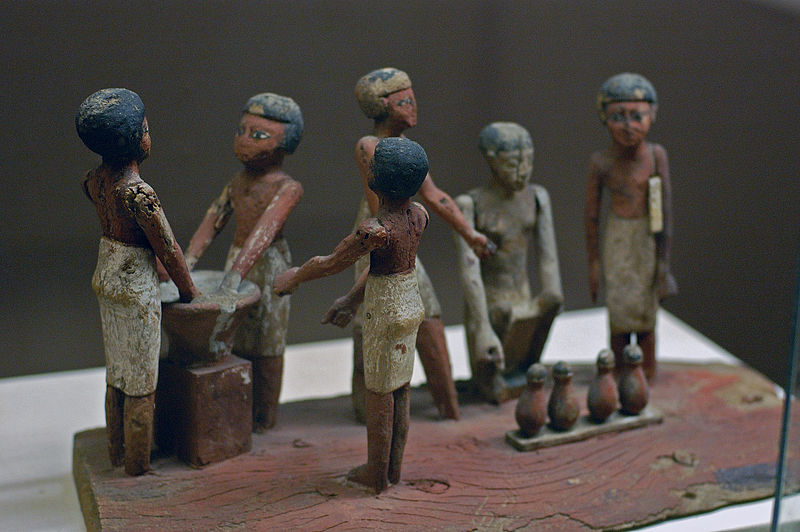
Model of Egyptian beer making.


Beer is the world's oldest and most widely consumed alcoholic beverage and the third most popular drink overall after water and tea. It is recorded in the written history of ancient Egypt and Mesopotamia. The earliest Sumerian writings contain references to beer. A prayer to the goddess Ninkasi known as "The Hymn to Ninkasi" serves as both a prayer as well as a method of remembering the recipe for beer in a culture with few literate people.

The process of making beer is known as brewing. A dedicated building for the making of beer is called a brewery, though beer can be made in the home and has been for much of beer's history. A company which makes beer is called either a brewery or a brewing company. The basic ingredients of beer are water; a starch source, such as malted barley, able to be fermented (converted into alcohol); a brewer's yeast to produce the fermentation; and a flavouring such as hops. Here is a basic run-thought of the process:

1. The first step, where the wort is prepared by mixing the starch source (normally malted barley) with hot water, is known as "mashing". Hot water (known as "liquor" in brewing terms) is mixed with crushed malt or malts (known as "grist") in a mash tun.

2. The grains are now washed in a process known as "sparging". This washing allows the brewer to gather as much of the fermentable liquid from the grains as possible.

3. The process of filtering the spent grain from the wort and sparge water is called wort separation. The tradition process for wort separation is lautering, in which the grain bed itself serves as the filter medium.

4. The sweet wort collected from sparging is put into a kettle, or "copper", (so called because these vessels were traditionally made from copper)[25] and boiled, usually for about one hour. During boiling, water in the wort evaporates, but the sugars and other components of the wort remain; this allows more efficient use of the starch sources in the beer.

5. . Hops are added during boiling in order to extract bitterness, flavour and aroma from them.

6. In some breweries, the hopped wort may pass through a hopback, which is a small vat filled with hops, to add aromatic hop flavouring and to act as a filter; but usually the hopped wort is simply cooled for the fermenter, where the yeast is added.

7. When the beer has fermented, it is packaged either into casks for cask ale or kegs, aluminum cans, or bottles for other sorts of beer.

Sources:
Wikipedia

Wednesday, 3 December 2008

Chemistry: Three Cycles


Water Cycle

1. Solar energy causes water in oceans, lakes, ponds or any other body of water to evaporate.
2.The water vapor formed condenses into clouds.
3. The clouds condense in to rain, hail, sleet or snow.
4. The runoff flows though rivers stream or under ground to bodies of water (Ex. ponds, lakes, oceans)
5. The process starts again.


Carbon and Oxygen Cycle

It involves 2 key processes:
1) Photosynthesis which uses sunlight, CO2 and water to produce carbohydrates and oxygen.
2) Respiration where animals and humans use oxygen along with carbohydrates to make energy and CO2 and water.
The output of one is the input of the other and it's clean, quiet, and efficient.
They help each other.


Nitrogen Cycle

1. Lightning and bacteria turn the atmospheric nitrogen into nitrogen compounds that can be absorbed by plants.
2. The plants incorporate these compounds into organic molecules.
3. Animals that eat these plants receive nitrogen.
4.When the plants and animals die, bacteria change the nitrogen compounds back into atmospheric nitrogen and in the soil.


Sources:
www.usgcrp.gov
www.uwsp.edu
www.windows.ucar.edu
Awake-February 2009

Wednesday, 26 November 2008

Chemistry: Glue-stick Rocket


Here is a way to make a simple rocket from household mateials.
What you will need:
Glue-stick
Vinegar
Baking soda
Cellophane (Plastic Wrap)
Knife (optional)
  1. Screw the glue all the way to the top, it should be able to be pulled right off. If not cut of with knife.
  2. Fill the glue-stick until it is about 1 cm from the brim with vinegar.
  3. Fill the cap 1 3rd with baking soda.
  4. Cover with enough cellophane to cover the baking soda but not stick out of the lid.
  5. Go to the launch site, quickly put the lid on the glue stick, shake lightly for a second and place on launch pad and wait for the launch.
Note: If it doesn't launch you may not have enough vinegar and/or baking soda. You may also have two much plastic wrap.

Wednesday, 12 November 2008

Chemistry: Quartz

Amethyst a variety of quarts.

Quarts is one of the most common minerals on earth. Quarts is Silicon dioxide (SiO2) . Quarts comes in a variety of colors but pure quartz is colorless or white. Quarts forms hexagonal prisms top with a pyramid. Quartz has a hardness of 7 on the Mohs scale and a density of 2.65 g/cm³.

The name "quartz" comes from the German "Quarz", which is of Slavic origin (Czech miners called it křemen). Other sources insist the name is from the Saxon word "Querkluftertz", meaning cross-vein ore.Quartz is important as a rock forming mineral and a semi-precious stone. Quarts makes up much of the dust in the air. Quarts leaves a white streak and has a specific gravity of 2.65 when pure. Quartz crystals can grow to huge sizes in pegmatites. a single crystal of approximately 40 tons was found in Brazil and one of 70 t0ns was found in Kazakstan.

Sources:
Wikimedia.
Wikipededia
Rocks and Fossils by Arther B. Busbey III, Robert R. Coenraads, David Roots and Paul Willis. (book)

Wednesday, 5 November 2008

Chemistry: Zinc


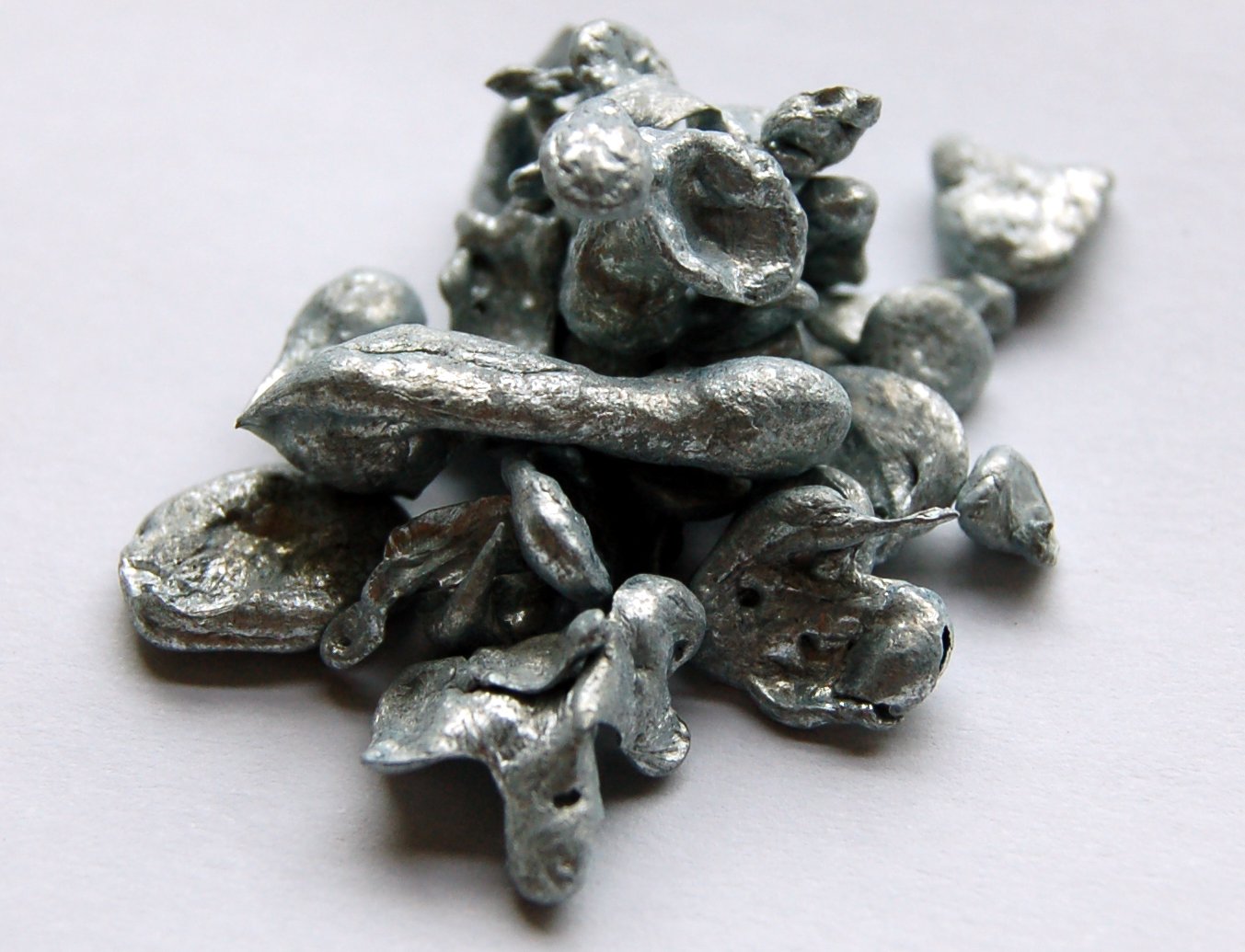
Zinc


Basic info:

Symbol: Zn
Atomic Number: 30
Atomic Mass: 65.409 (4) g/mol
Electrons per shell: 2, 8, 18, 2,
Appearance: bluish pale gray
Melting point: 692.68 K, 419.53 C, 787.15 F
Boiling point: 1180 K, 907 C, 1665 F

Zinc is a solid Transition Metal. Zinc is found in rocks, soil, air, and the biosphere. Plants and Animals contain zinc. Minerals and metals are mostly obtained from the earth’s crust. The average level of zinc in earths crust is 70 mg/kg (dry weight), some areas more than others. Some major zinc mining countries are: China, Australia, Peru, Europe and Canada. There are for types of zinc deposits: Volcanic hosted massive sulphides (VMS), Carbonate hosted, Sediment hosted (sedex deposits), Intrusion related (high sulphidation, skarn, manto, vein). Zinc is normally found with lead, copper, gold, or silver. The most common zinc mineral is sphalerite (ZnS).

Zinc ores were used centuries before zinc was discovered, it was used to make brass and zinc compounds. It's ore was also used to heal wounds and sore eyes.It is believed that the Romans first made brass in the time of Augustus (20 B.C. – 14 A.D.). Marco polo described zinc oxide manufacturing in Persia in the 13th century. By 1374, zinc was recognized in India as a new metal – the 8th metal known to man at that time. Zinc metal and zinc oxide were manufactured in Zawar, India from the 12th to the 16 century. Zinc Production moved to China in the 17th century. Zinc was recognized in Europe as a separate metal in the 16th century when Agricola observed that a metal called “zincum” was produced in Slesia and Paracelsus stated clearly that '“zincum” was a new metal. Europe's first zinc smelter was in Bristol, U.K. In 1916 the electrolytic process replaced the pyrometallurgical process.

Zinc has a number of uses from brass to batteries. Zinc is essential for the normal healthy growth and reproduction of plants, animals and humans. Zinc is a very important metal.

Sources:
Wikipedia
American Zinc Association


Followers

About This Blog

I am a grade nine student living in Mexico. This is my home school education blog. I post the things I learned during the week on this blog. I hope you can learn things from this too.


  © Blogger template 'Photoblog II' by Ourblogtemplates.com 2008

Back to TOP