Labels


Showing posts with label Math. Show all posts

Thursday, 8 October 2009

Math: Properties of Numbers

Basically the laws of mathematics. 1-5

1. The Reflexive Property of Equality

A number is equal to itself.

Ex. 3 = 3

2. The Symmetric Property of Equality

If one value is equal to another, then the second value is the same as the first.

Ex. A = B is the same as B = A

3. The Transitive Property of Equality

If one value equals a second, and the second value equals a third, then the third is equal to the first.

Ex. If A = B and B = C then C = A

4. The Substitution Property.

If one value is equal to another, then the second can used in place of the first in any algebraic expression dealing with the first.

Ex. If: A = B and A + C = D then B + C = D too.

5. The Additive Property of Equality

We can add equal values to both sides of the equation without changing the validity of the equation.

Ex. A + 3 = B + 3 is the same as A +B.

They're quite simple. This is mainly for reference.

Sources: Youtube

Thursday, 14 May 2009

Math: How to bisect an angle.

Here is a you tube video on how to bisect a triangle. Youtube

Friday, 12 December 2008

Math: Fibonacci numbers


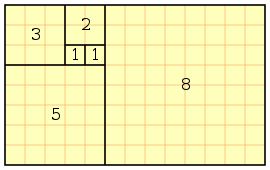
The Fibonacci spiral


In mathematics, the Fibonacci numbers are a sequence of numbers named after Leonardo of Pisa, known as Fibonacci (a contraction of filius Bonaccio, "son of Bonaccio"). Fibonacci's 1202 book Liber Abaci introduced the sequence to Western European mathematics, although the sequence had been previously described in Indian mathematics.

Here is an example:
The first number is 0; the second number is 1.
0 + 1 = 1
1 is the third number.
1 + 1 (The previous number) = 2
2 is the fourth number.
1 + 2 = 3
3 is the fifth number.
2 + 3 = 5
5 is the sixth number.

The sequence created is:

0 1 1 2 3 5

The next number is 8.

Here is a chart.


Each side length of a square is a Fibonacci number.


Uses

The Fibonacci number series is used for optional lossy compression in the IFF 8SVX audio file format used on Amiga computers.

The Fibonacci numbers occur in the sums of "shallow" diagonals in Pascal's triangle and Lozanić's triangle (see "Binomial coefficient").

These are only two there are more.

In Nature


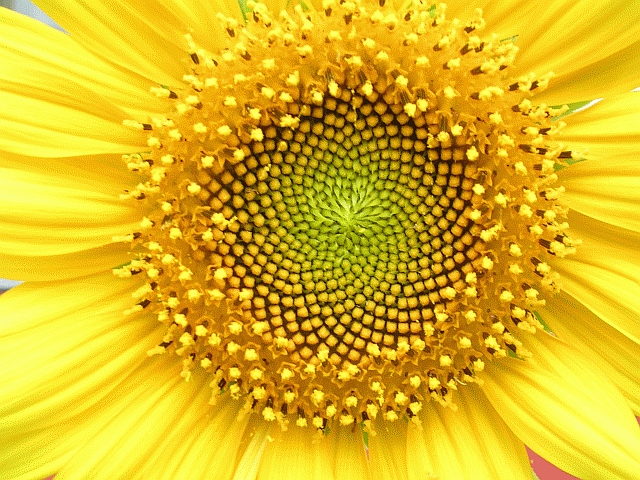
Sunflower showing pattern in seed layout


Fibonacci sequences appear in biological settings, in two consecutive Fibonacci numbers, such as branching in trees, arrangement of leaves on a stem, the fruitlets of a pineapple, the flowering of artichoke, an uncurling fern and the arrangement of a pine cone. In addition, numerous poorly substantiated claims of Fibonacci numbers or golden sections in nature are found in popular sources, e.g. relating to the breeding of rabbits, the spirals of shells, and the curve of waves. The Fibonacci numbers are also found in the family tree of honeybees.

Sources:
Wikipedia

Thursday, 4 December 2008

Math: Rhombicosidodecahedron


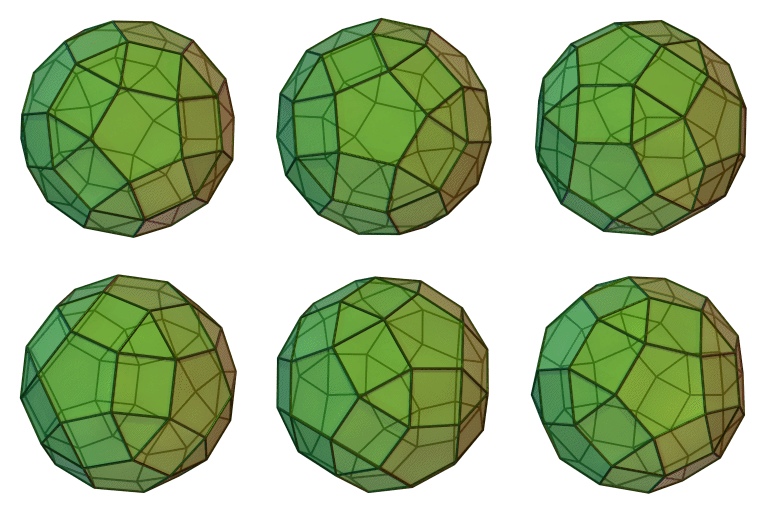
The rhom-bico-sido-deca-hedron, or small rhombicosidodecahedron, is an Archimedean solid (an Archimedean solid is a highly symmetric, semi-regular convex polyhedron composed of two or more types of regular polygons meeting in identical vertices).

It has 20 regular triangular faces, 30 square faces, 12 regular pentagonal faces, 60 vertices and 120 edges. 20{3}+30{4}+12{5} 3=triangle 4=square 5=pentagon

The name (rhomb(ic)osidodeca)hedron refers to the fact that the 30 square faces lie in the same planes as the 30 faces of the rhombic triacontahedron(30 rhombic faces) which is dual to the icosidodecahedron(20 triangles, 12 pentagons).

If you blow up an icosahedron by moving the faces away from the origin the right amount, without changing the orientation or size of the faces, and do the same to its dual dodecahedron, and patch the square holes in the result, you get a rhombicosadodecahedron.

Source: Wikipedia
Math World

Thursday, 27 November 2008

Math/Social Studies: Sextant and how it tells latitude


Antique sextant


  • A sextant is a device the measures the angle of a celestial body. Ex. planets, the moon, the sun or other stars.
  • Polaris (the North Star) is above the north pole at 90*.
  • The mariner’s quadrant is a device similar to the sextant. The quadrant is one quarter of a circle.
  • The quadrant can be traced back to 1200s, but it was around 1450 that the quadrant came into widespread use.
  • During the 1400’s, Portuguese explorers were traveling south along the coast of Africa searching for a route to the orient. As a seafarer nears the equator heading south, Polaris disappears below the horizon. So, in southern seas, mariners had to have a different way of finding their latitude. Under orders from the Portuguese Prince Henry, The Navigator, by 1480, Portuguese astronomers had figured out how to determine latitude using the position of the sun as it moved north and south of the equator with the seasons, what we now call its "declination."
  • The quadrant had two major limitations: On a windy, rolling deck, it was hard to keep it exactly vertical in the plane of a heavenly body. And it was simply impossible to keep the wind from blowing the plumb bob off line.
  • In about 1731 John Hadley in England and by Thomas Godfrey independently and almost simultaneously, thought of the fundamental idea is to use of two mirrors to make a doubly reflecting instrument—the forerunner of the modern sextant.
How it tells latitude: For example, if the sun is at 0* (the equator) and you are at 90* (the north pole) the sun will be on the horizon. As you head toward the equator the angle between the horizon and the sun will increase, from 0* (at the north pole) to 90* (at the equator).

Illustration. One line points to the sun. The sextant works in a similar way giving the exact angle.

Sources:
landandseacollection.com
The History of the sextant

Thursday, 20 November 2008

Math: Tessellation


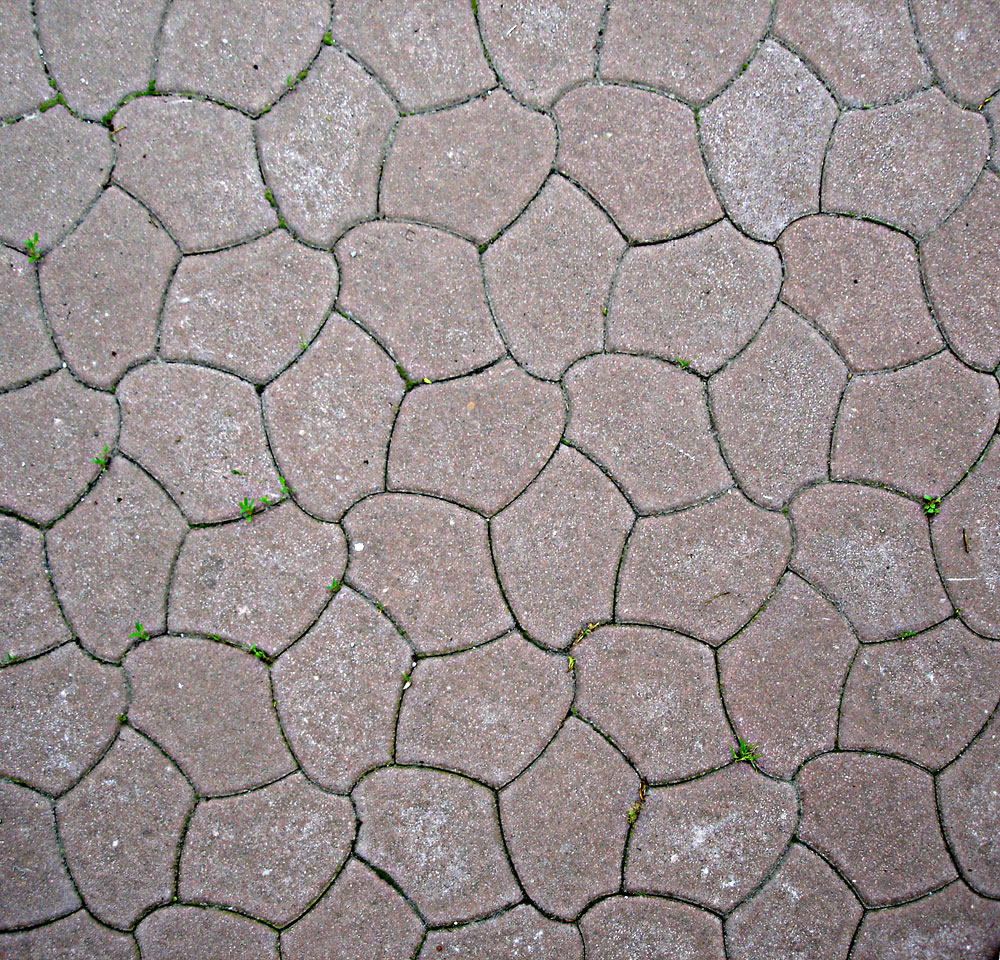
Street Pavement


Giant's Causeway, Ireland


A tessellation or tiling of the plane is a collection of plane figures that fills the plane with no overlaps and no gaps.

A regular tessellation is a mosaic with all pieces being the same size ans shape.

A semi regular tessellation is one that has more than on shape filling the plane.

In computer-aided design, arbitrary 3D shapes are often too complicated to analyze directly. So they are divided (tessellated) into a mesh of small, easy-to-analyze pieces -- usually either irregular tetrahedrons, or irregular hexahedrons. There a tessellations in nature. Columnar Jointing and Tessellated Pavement are geological formations made in nature. Tessellations frequently appeared in the art of M. C. Escher.


Sources
Wikipedia

Thursday, 13 November 2008

Math: Fractal


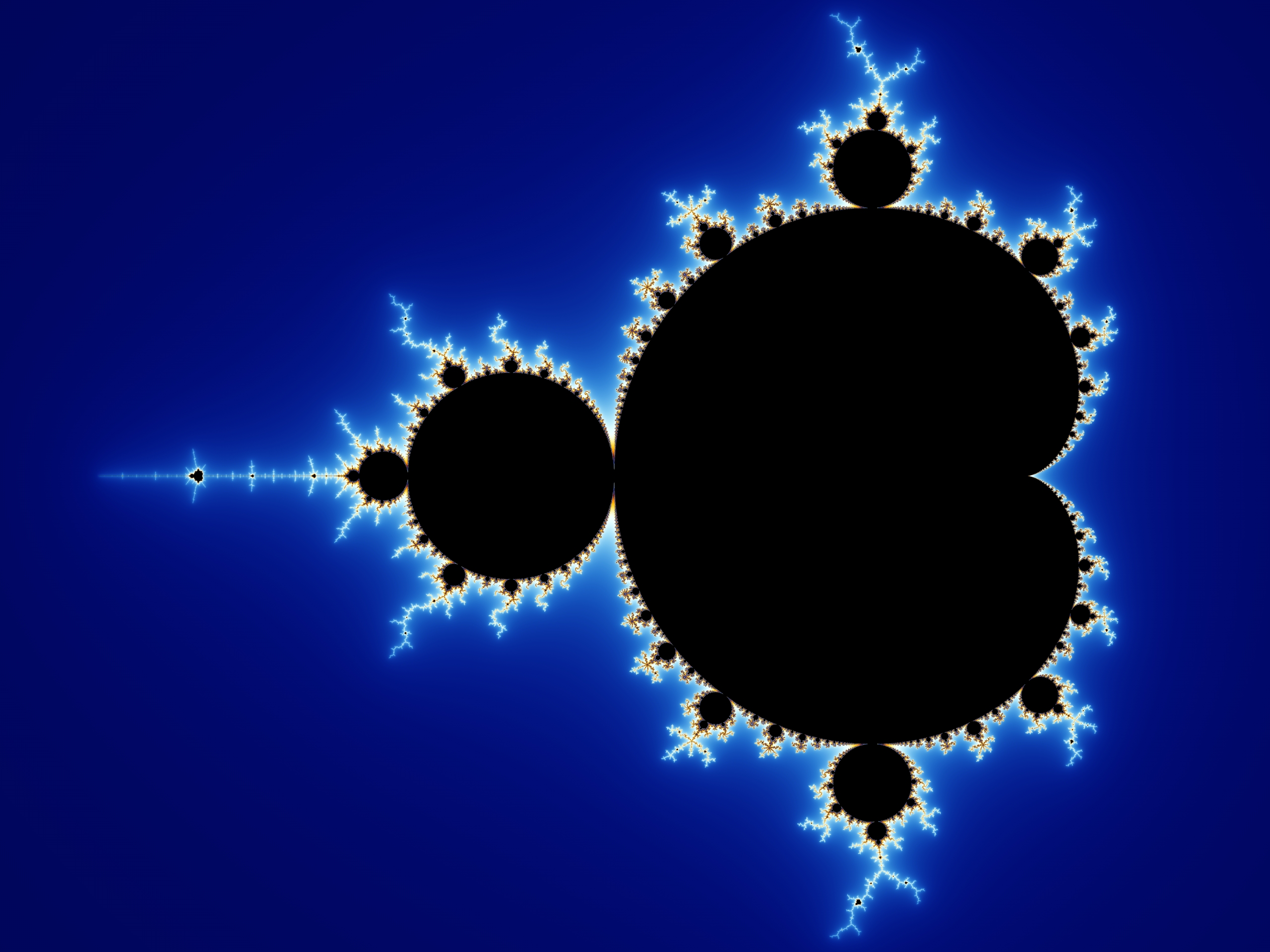
Mandelbrot set


A fractal is generally "a rough or fragmented" geometric shape that can be split into parts, each of which is (at least approximately) a reduced-size copy of the whole," a property called Self similarity. It can be a simple shape or line that divides in to a smaller shapes or lines and so on. The term was coined by Benoit Mandelbrot in 1975 and was derived from the Latin fractus meaning "broken" or "fractured."

The prototypical example for a fractal is the length of a coastline measured with different length rulers. The shorter the ruler, the longer the length measured, a paradox known as the Coastline Paradox. The mathamatics behind fractals began to take shape in the 17th century when mathematician and philosopher Leibniz considered recursive self-similarity (although he made the mistake of thinking that only the straight line was self-similar in this sense).

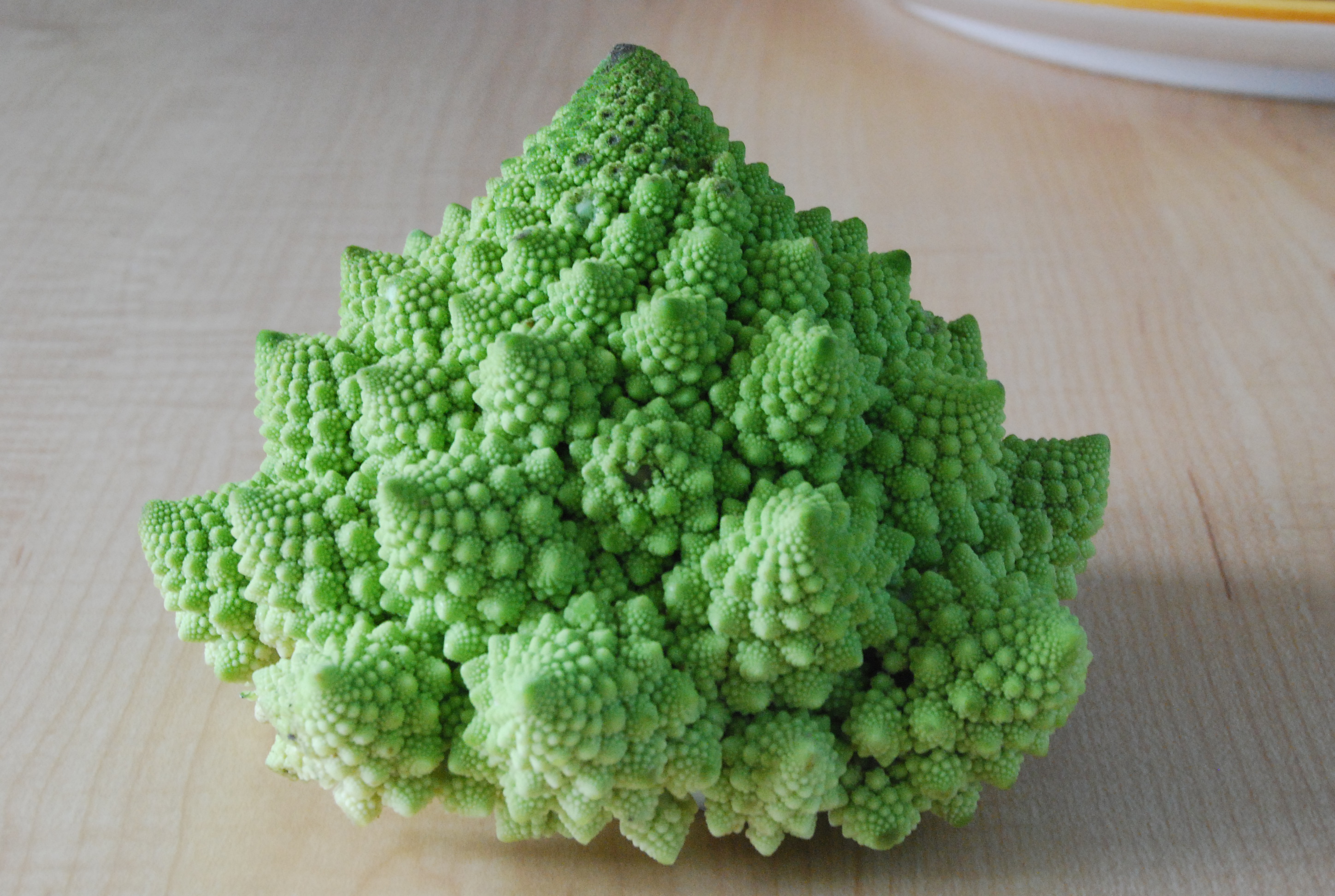
Fractals can occur in nature too. some examples are: Snow flakes, mountain ranges, crystals, lighting, cauliflower, broccoli, blood vessels, Pulmonary vessels, trees, ferns, and coastlines may be loosely considered fractal in nature.


Romanesco broccoli shows natural fractals

Sources: Wikipedia
Wolfram MathWorld


Thursday, 6 November 2008

Math: What is a Googol?

A googol is the large number 10100, that is, the digit 1 followed by one hundred zeros (in decimal representation). The term was coined in 1938 by Milton Sirotta. Kasner popularized the concept in his book Mathematics and the Imagination (1940).

A googol can be written in conventional notation as follows:

1 googol
= 10100
= 10,​000,000,000,​000,000,000,​000,000,000,​000,000,000,​ 000,000,000,​000,000,000,​000,000,000,​000,000,000,​000,000,000,​ 000,000,000,​000,000,000
Its official English number name is ten duotrigintillion on the short scale, ten thousand sexdecillion on the long scale, or ten sexdecilliard on the Peletier long scale.

Googolplex

A googolplex is the number one followed by one googol zeroes, or ten raised to the power of one googol:

10googol = 10(10100).

Googol and comparable large numbers

A googol is greater than the number of atoms in the observable universe, which has been variously estimated from 1079 up to 1081.

Less than a googol Planck times have elapsed since the Big Bang (the current figure stands at around 8×1060 Planck times). Similarly, the size of the observable universe is about 9×10185 cubic Planck lengths. From the previous figures it can be seen that a list of positions of every particle at every possible instant of time, at the maximum possible accuracy, would contain well over a googol entries (of the order of 10325), but still far less than a googolplex. Avogadro's number, 6.02214179×10²³, is exactly the number of 12C atoms in 12 grams (0.012 kg) of unbound 12C in its ground state.

It is perhaps the most widely known large number from chemistry and physics.

Black holes are presumed to evaporate because they faintly give off Hawking radiation; if so, a supermassive black hole would take about a googol years to evaporate.

Seventy factorial, or 70!, is 1.19785717 × 10100. This means that there are over a googol ways to arrange seventy items (or people) in a sequence (such as a line to a concert).

The Shannon number, 10120, a rough lower bound on the number of possible chess games, is more than a googol.

Source: Wikipedia

Followers

About This Blog

I am a grade nine student living in Mexico. This is my home school education blog. I post the things I learned during the week on this blog. I hope you can learn things from this too.


  © Blogger template 'Photoblog II' by Ourblogtemplates.com 2008

Back to TOP